Knowledge creation
FGV EAESP's Study Centers and Research Initiation Program (PIP) are responsible for producing academic and applied knowledge.

21 study centers that generate knowledge for society
Our Study Centers have the mission of creating and disseminating applied research, generating a positive impact on organizations and Brazilian society.

Centros de Estudos
- FGVanalytics
Center for Analytics and Security Policy Studies
The Center for Analytics and Security Policy Studies is dedicated to research to accelerate the use of Big Data and AI in public security.
- FGVceapg
Center for Public Administration and Government Studies (CEAPG)
The Getulio Vargas Foundation's Center for Public Administration and Government Studies (CEAPG) conducts applied research and trains researchers and managers, with the aim of generating and disseminating knowledge, contributing to the improvement of public management and the deepening of Brazilian democracy.
- FGVcef
Center for Financial Studies
The Center for Financial Studies fosters research and provides students and professionals with a broader knowledge of finance.
- FGVcei
Center for International Competitiveness Studies
The Center for International Competitiveness Studies prepares professionals to operate in a globalized market.
- FGVceisa
Center for Infrastructure Studies and Environmental Solutions
The Center for Infrastructure Studies and Environmental Solutions discusses infrastructure and environmental issues, including planning and regulation.
- FGVcelog
Center for Value Chain, Supply Ecosystem, and Logistics Studies
The Center for Value Chain, Supply Ecosystem, and Logistics Studies aims to foster the country's development through better logistics performance in companies.
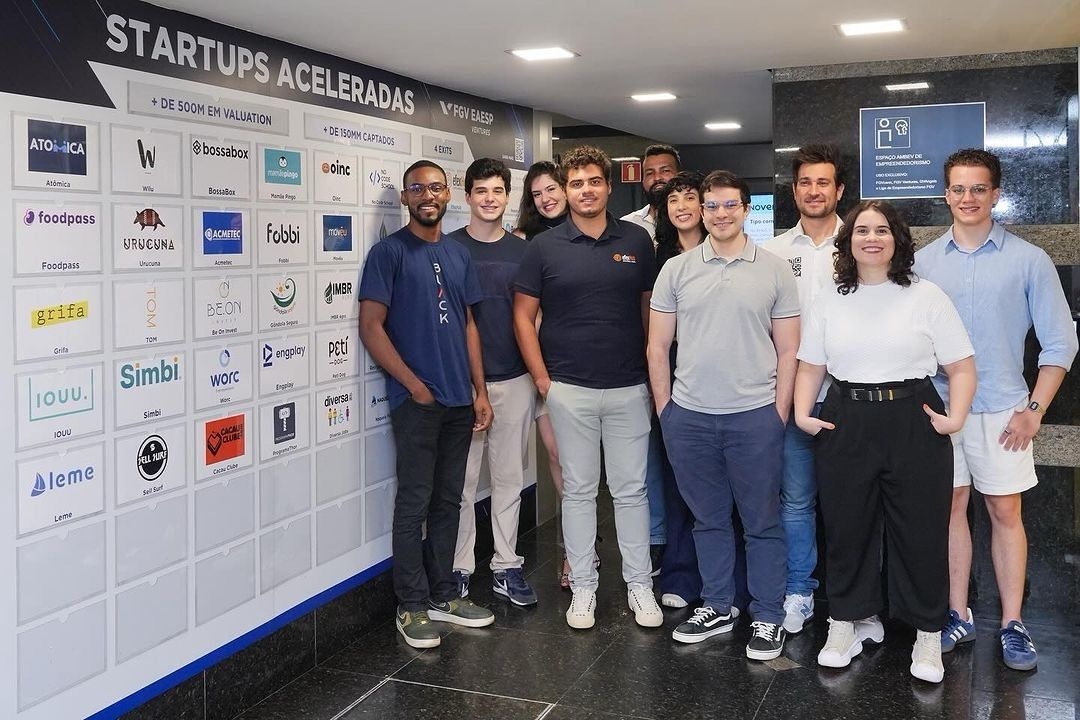
FGV startup accelerator
FGV Ventures
We support the creation of new businesses by FGV students, alumni, professors and researchers. The acceleration program offers workshops, individual meetings for strategic guidance, mentoring and connections with partners, so that businesses can advance and gain scale.
9 Research Areas That Generate Knowledge for the Advancement of Science
Our Research Areas are dedicated to creating and disseminating academic knowledge, contributing to the advancement of management science.
Business Administration
The line of research in Business Strategy has contributed to the advancement of scientific knowledge in Strategy in Brazil. Its research focuses on the following areas: Organizational Performance and Development, Corporate Internationalization, Innovation and Entrepreneurship and Non-Market Strategies. The general questions that the line seeks to answer relate to: Strategy and Organizational Analysis, Business Internationalization and Entrepreneurship and Innovation.
The Marketing research line includes different aspects of marketing studies, involving both the macro level (of the company or economic activity) and the micro level (of the individual), as well as different research paradigms and methods.
Among the research topics developed within the scope of the line are: the construction and evolution of markets and brands; marketing performance and metrics; digital disruption; marketing strategies; marketing channel management; the impact of marketing on well-being and society; services marketing and value co-creation; consumer psychology; consumer meanings, practices and trends.
The line's research has focused on diverse contexts, such as organizations in the retail and service sectors, non-profit organizations, consumption and consumers in the digital environment.
Researchers from a variety of backgrounds (Social Communication, Law, Economics, Engineering, Mathematics, Psychology, Sociology, among others) are welcome for the master's and doctoral courses, or post-doctoral studies.
The field of Organizational Studies has grown and consolidated substantially over the last five decades, and today includes an expressive variety of themes, epistemological currents, methodologies and approaches.
At FGV EAESP, the Organizational Studies group was formed based on the guidance and classic contributions of Fernando Claudio Prestes Motta, Ramon Garcia and Mauricio Tragtenberg. These contributions were characterized by a reflexive and critical view of organizations and their dynamics.
In its current configuration, the Organizational Studies Research Line aims to carry out studies that continue this tradition and draw on the most recent theoretical advances in the field in Brazil and worldwide.
The central theme of the Operations Management and Sustainability research line is the role of operations management for performance and competitiveness. Traditional operations management themes such as operations strategy, logistics, supply chain management, service management, quality and processes are part of the research interests of its researchers.
In addition, broader themes are addressed such as: sustainable development and its impact on the environment; industrial clusters; sustainability strategies; and, innovation.
FGV EAESP's line of research in Finance has already trained more than 300 researchers (including Masters and PhDs), who have held prominent positions in academia, government and industry. During the course, students invariably undertake internships at renowned institutions abroad, including: University of Cambridge, University of California, University of Texas, University of Colorado, University of Lancaster, University of New York, University of Illinois, Instituto de Empresa (IE) de Madrid, University of Georgia, and Stanford University.
The Finance line has a range of professors whose specialties cover the entire spectrum of Finance: corporate finance (including international finance and corporate governance), investments and asset pricing, behavioral finance, banking, regulation and financial stability. Also noteworthy is the prioritization of the social impact, as well as the potential contribution to innovation, of the scientific production of the FGV EAESP Finance Line.
Managers need to anticipate, understand and adapt their decisions to the constraints of economic and social life, which today is largely permeated by the intense generation of data and the widespread use of information technology.
The Administration, Analysis and Information Technology research line aims to foster the development of relevant knowledge in the field of technology and information, as well as to train people capable of identifying, understanding, developing and disseminating this knowledge. The line emphasizes its actions in proposing solutions to real problems associated with the use of information and its technologies, focusing on multiple perspectives and levels of analysis, and employing a broad spectrum of analytical techniques.
In particular, the line recognizes the importance of publications in the list of journals known in the research field as Senior Basket, as well as in the international congresses of the Association for Information Systems - AIS, listed below. At the local level, the line is referenced in the congresses of EnAnpad - National Association of Graduate Programs in Administration, especially EnADI - National Meeting of Information Administration.
Public Administration and Government
The Government and Civil Society research area develops teaching and research activities focused on the study of the public sphere, emphasizing the relationship between public administration and civil society in subnational contexts. It addresses topics such as local governments; civil society participation in public policy; public action; civil society and the third sector; networks; social movements; rights, participation, and citizenship; government; territoriality; and governance.
The Public Sector Politics and Economics research area examines the relationship between politics and the public sector economy, analyzing different levels of government from a political-institutional perspective. Its topics include public revenues and expenditures; economic internationalization; the political economy of regulation; the relationship between political institutions and public spending; economic-institutional studies on corruption; monetary policy; regional development; the political economy of urban intervention; efficiency of public spending (especially in Education and Health); macroeconomic policies linked to development strategies for middle-income countries; local public finance management; comparative politics; and electoral behavior.
The State Transformations and Public Policy research area investigates new institutional and managerial models adopted by governments in contemporary democracies, with the goal of understanding patterns of state intervention. Its themes relate to reforms proposed by New Public Management and New Public Governance, as well as institutional changes, particularly regarding public sector accountability and efficiency, from a comparative perspective.
Research Initiation Program

O Programa de Iniciação à Pesquisa (PIP) destina-se aos alunos(as) da FGV interessados em seguir carreira acadêmica ou em incorporar conhecimentos mais profundos sobre investigação científica às suas futuras atividades profissionais.
O objetivo do PIP é promover a troca de conhecimentos entre alunos(as), gestores(as), comunidades, associações, organizações sociais, empresários(as) e especialistas, com o acompanhamento e supervisão de professores(as) da FGV.
O Programa visa também aproximar estudantes das diversas realidades brasileiras, fomentando posturas humanistas, colaborativas, pró-ativas e empreendedoras.
O PIP integra três iniciativas:
- Residência em Pesquisa - para alunos de graduação e mestrado
- Projeto Conexão Local - para alunos de graduação e pós-graduação
Programa Institucional de Bolsas de Iniciação Científica (PIBIC) e de Inovação Tecnológica (PIBITI) - para alunos de graduação
Research Residency
It allows undergraduates to take part in research projects at the FGV Study Centers for 4 months per semester.
Local Connection
It encourages the involvement of undergraduate and postgraduate students in innovative experiences .
Institutional Program for Scientific Initiation Scholarships (PIBIC)
This initiative aims to stimulate the production of scientific knowledge by undergraduate students.
