Inaugural class presents competitiveness and sustainability in practice
February marks the beginning of a new academic journey for students at the São Paulo School of Business Administration (FGV EAESP). In the Professional Master's in Management for Competitiveness (MPGC), the largest professional master's degree in Brazil, the first course of the course is not only an introduction to the program content, but also a strategic opportunity for integration and networking for the almost 150 new students.
The program kicked off with the Competitiveness Trends course, taught by Professor Gilberto Sarfati, coordinator of the MPGC. The course has an integrative and thought-provoking role: it proposes a reflection on the meaning of competitiveness and its multiple dimensions — organizational, human and institutional — in addition to connecting theory and practice to prepare students for real challenges in the business world.
Competitiveness and sustainability in practice
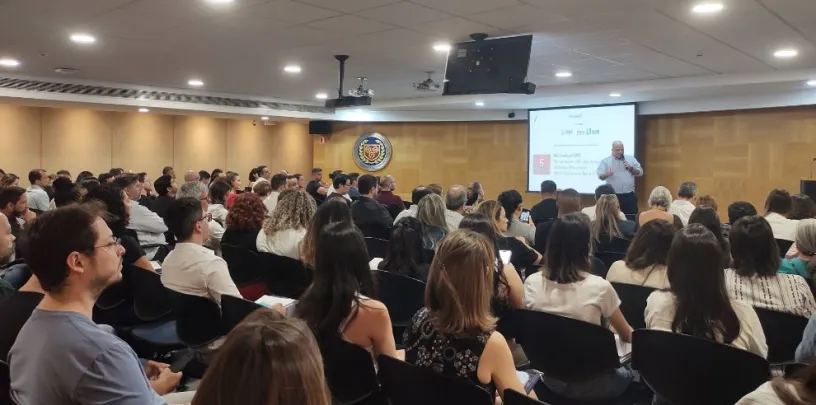
The inaugural class featured a talk by Bruno Serapião, CEO of Atvos, one of the largest clean energy companies in Brazil. In his speech, entitled “The Role of Companies in Competitiveness and Sustainable Development,” Serapião presented his experience leading the company and highlighted how it is possible to combine profitability with values such as sustainability, active governance and people management. He also reinforced the importance of leadership to ensure clarity in objectives and maintain focus on human capital, factors that directly impact organizational results.
In addition to the lecture, students had sessions with the coordinators of their respective research lines, deepening the concept of competitiveness in their specific sectors. The Competitiveness Trends discipline connects all eight MPGC lines and promotes a dynamic learning experience, with lectures, dialogues, group dynamics and interactive activities.
Simultaneous panels and interdisciplinary exchanges
During the course, students participated in several simultaneous panels. The topics covered reflected contemporary challenges and emerging trends, including artificial intelligence, sustainable leadership, political challenges of 2025, geopolitics, mental health, intergenerational dialogue and climate change.
Another highlight was the contact with some MPGC alumni, who shared their experiences and answered questions, enriching the exchange of knowledge between generations and preparing the new class for the challenges of the master's degree.
Professor Fernanda Carreira led an integration dynamic, allowing students to meet colleagues from other lines of research and reflect on their expectations for the next two years of the master's degree.
Reflections on competitiveness and purpose
More than presenting theoretical concepts, the course challenges students to question and deepen their understanding of competitiveness. Professor Gilberto Sarfati provoked reflections on current dilemmas, such as: Do competitiveness and profitability always go hand in hand? Is it possible to reconcile professional purpose with high remuneration?
Over the course of 16 sessions, students deepened their understanding of competitiveness through research and practical discussions, exploring its relationship with the importance of health and well-being, diversity and inclusion as strategic factors, innovation trends that influence companies and the impact of climate change on the institutional landscape.
With this first module, the MPGC 2025 class begins its academic journey encouraged to think critically and apply the knowledge acquired in real scenarios.