Research shows that steel mill suppliers have a low level of adherence to decarbonization
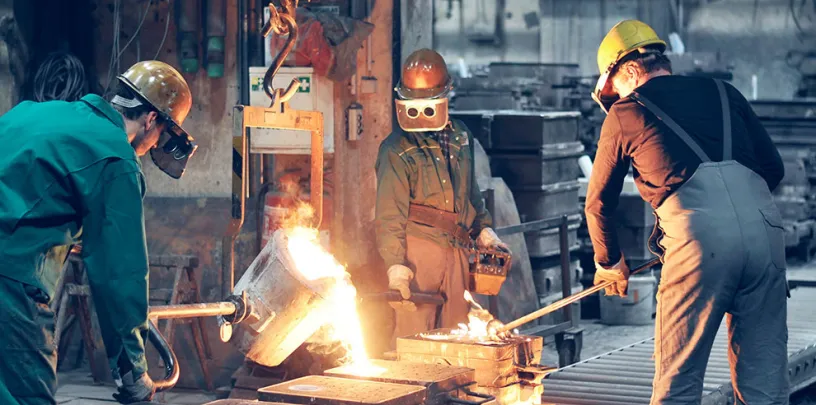
Climate change is already a reality and the pressure on companies to adopt measures to mitigate the effects of these changes is increasing. Faced with this market reality, research developed within FGV investigates the reality and drivers of a supply chain in the steel industry, one of the most polluting in terms of carbon emissions.
Marino Yago Fagundes' master's research, which won an Honorable Mention in the Professional Master's program in Management for Competitiveness (MPGC) at the São Paulo School of Business Administration (FGV EAESP), sought to investigate whether the suppliers of a steel company have decarbonization strategies and what would be the motivators to adopt such strategies. Emissions arising from the supply chain are relevant but still seen as a non-mandatory measurement item within greenhouse gas measurement protocols, which generates less attention regarding the topic.
In general, it was observed that there is still a low level of adherence to decarbonization strategies in the studied supply chain, however there is a sign that a relevant part of the responding companies are evaluating or planning the adoption of strategies for the future.
Yago spoke to FGV detailing his research results and their impact on academia and the business world. Check out the interview:
His research object was “are suppliers of steel raw materials adopting decarbonization strategies? What strategies are being adopted and what are their motivators?” Which path led you to this question?
When I started my master's degree I wanted to research another subject, but halfway through I realized that the hot topic of the company I worked for was different. The paths were all focused on discussing climate issues and decarbonization in the steel industry, which is naturally very polluting. With this perception of the business world, I found a gap, as everyone was talking about climate issues but didn't know how to do it, where to go or exactly what it was about. It is extremely difficult, when looking for supply chain research, to find the topic of decarbonization. Everything is focused on the company itself, on what it does directly, but for its chain there is a huge literary gap.
And what did your results indicate?
The first point is this gap in the literature and we can see it reflected in the business environment. We don’t have theory and we also don’t have people working empirically on the subject. We carried out a cluster analysis to understand the situation of suppliers in this area and found only two types of companies. I expected to find several levels of development, a model company, one in transition, a start-up, and so on. That's not what I found, there were just two levels: those who were effectively beginners, with some degree of motivation and intention to think about the subject, but had no governance or implemented strategy. And it has a profile with a higher degree of motivation, a certain level of governance and that already implements some level of strategy. There is no intermediate level between those who do it and those who don't. This is within the scope of companies of all sizes, from small to multinationals. In other words, it is a topic that is still beginning to gain traction in the market and we do not have good models of supplier companies that have strategies for reducing greenhouse gas emissions.
What factors can influence a company to want to adopt decarbonization strategies?
In the research we saw that the factors of nationality and whether the company is publicly traded or not are influencing factors. This is due to legislation. Companies that were based in Europe were generally more advanced on the subject because Europe is leading these discussions worldwide and is implementing regulation on this in a more intense way. Publicly traded companies are generally more regulated, more transparent and were the companies that were most engaged in the survey data.
What were the motivators you found for companies to engage in the topic of decarbonization?
The biggest pressure factor found in the research were customers, that is, the steel mills to which they supplied. On the other hand, employee pressure was the item that had the least influence. In other words, what the employee thinks is of little relevance to decision-making regarding sustainability, suppliers are more concerned with the customer's position. Along with customers, internal risk assessment and incentives or pressure from society were the most relevant factors. This gives guidance on the pressure point that has to be used for policies to develop both within companies and for public policies. I believe that the research also provides guidance for those who are legislating.
We are starting this discussion of decarbonization in the supply chain, but what are the next steps?
The industry is still very little engaged in relation to decarbonization. Research has shown that part of the problem is due to a lack of legislation. Congress is already discussing something about regulating the carbon market. Europe already has a tax per ton per greenhouse gas emitted, but protocols for measuring these gases generally oblige companies to measure scope 1 and 2, which concern the gases that the company emits (1) and that come from energy it expends (2). Scope 3, covered in my research, talks about indirect emissions, which come from suppliers and customers, and measurement is generally optional in legislation. Europe, the vanguard in this discussion, realized that there is no point in scope 1 and 2 being mandatory and scope 3 not. Companies began to send very polluting operations to another country whose regulation is not as strong and which would not be subject to taxation. This is what they called carbon leakage and a new protocol is being discussed to avoid this type of deviation, in which, regardless of where the emission comes from, it must be measured within the tax. This will impact the whole world. Anyone who is not prepared will be in for a very unpleasant surprise. Because it will generate more costs, it will influence the ability to export the product. Business competitiveness will be influenced if companies are not prepared.
And is Brazil prepared?
No, too far. Despite the enormous potential with agriculture and land, we can, for example, plant eucalyptus to generate biomass and have clean energy. We live on hydroelectric energy, which is clean, and we have more potential for wind energy. What Brazil has to prepare for is organic, no one has moved towards this, the country already has this potential and now has the chance to generate a competitive sustainability advantage. But in terms of companies' preparation, we saw that everything is still very early. There is still a lot to be done.
What advice do you have for supply chain professionals in this scenario?
Supply professionals increasingly have to know a little bit of everything. In the past it was about logistics, distribution and storage. This is expanding, now it is necessary to understand automation, information technology, global chains. Now, more than ever, supply professionals need to be able to understand this sustainability scenario. Both because of what it actually means to society, its image as a company, but also because it influences day-to-day decision-making. With new taxes on greenhouse gas emissions, the most polluting supplier may be more expensive than the less polluting one, which has a higher price for the product. I believe that the zero carbon certifications that exist can generate a lot of money in the medium term for those who surf this wave. Today, professionals need to understand how sustainability aspects impact business and how this can result in costs for the business. These are skills that professionals are not yet accustomed to.
Did the Professional Master's in Supply Chain help you prepare more for this new scenario?
It gave me a much more holistic view of the chain. I came from two latu sensu specializations and both of them left something to be desired, it wasn't what I expected. The master's degree exceeded my expectations by combining 3 things that I think are important: technical knowledge, with a more holistic view of the chain and the themes that permeate the chain, including sustainability. Second, I gained an evidence-based management skill that is missing in the market. There are many people who make decisions based on feeling. Third, the evolution of soft skills. The level of networking was fantastic and so were the exchanges in the classroom. The level of professionals is very high, all very interested in learning, with prior experience that contributes a lot.
To find out more about the Professional Master's in Supply Chain, visit the website .