Note of condolence: Ary Oswaldo Mattos Filho - FGV Direito SP
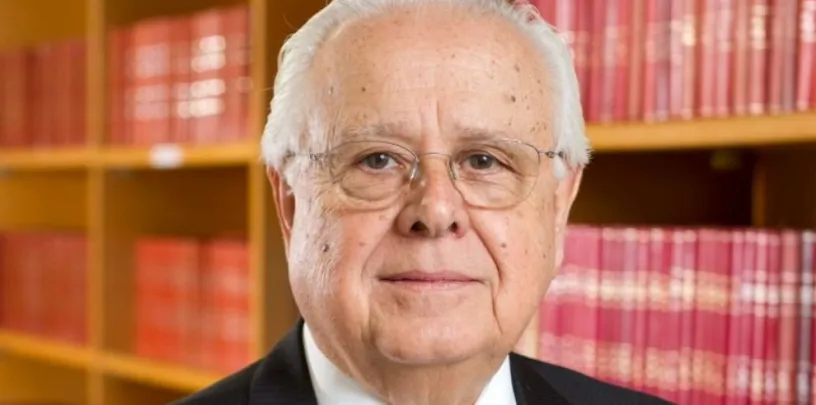
It is with immense sadness that FGV Direito SP announces the passing of its founder, director emeritus, and senior professor, Ary Oswaldo Mattos Filho, at the age of 85.
Born on January 11, 1940, in São Paulo, Ary Oswaldo graduated in Law from the University of São Paulo (USP) in 1965. He earned a master's degree in Commercial Law from USP between 1966 and 1969 and completed his LL.M. at Harvard University with a thesis entitled "Tax incentives in the northeast of Brazil ," also in 1969. The following year, he began his doctoral studies in Tax Law at USP, completing the course in 1973. He completed his training in 1984 with a postdoctoral period, also at Harvard.
While conducting research on international taxation, the legal personality of commercial companies, and tax incentives, Ary Oswaldo was already a renowned tax lawyer when he decided to apply for a professorship in Law at the FGV School of Business Administration (FGV EAESP) in São Paulo in 1969. “At Harvard, I was an attentive observer of a completely different teaching system, focused on developing skills indispensable for the practice of legal professions, as well as a daily critical exercise of the functioning of legal norms. I interacted with professors who were always at the school, with students who were totally dedicated to their studies, with academic professionals who researched and discussed legal problems taking into account the American political and legal reality. It was, in short, a 'brave new world',” he said in an interview given in 2008 for the book “Construction of a Dream,” which tells the story of the creation of FGV Direito SP. Based on that experience, years later, he accepted the challenge of founding the FGV Law School in São Paulo.
Ary Oswaldo was a professor at FGV EAESP for over 30 years. He took a brief leave of absence in 1990 when he was chosen to head the Brazilian Securities and Exchange Commission (CVM), a position he held until 1992. His tenure was marked by great challenges, but also by extremely relevant advances for the Brazilian capital market. The professor took over the CVM during one of the most turbulent periods in the Brazilian capital market. He inherited from the previous administration the responsibility of managing the consequences of the collapse of the Rio de Janeiro Stock Exchange. He also had to face the enormous distrust of savers after the failed freeze on funds held in financial investments implemented during the Collor Plan by then-President Fernando Collor de Mello.
Despite the challenges of the national scenario, Ary Oswaldo managed to carry out extremely relevant advances at the CVM (Brazilian Securities and Exchange Commission) that built the foundations of the current Brazilian capital market. It was during his tenure that the country's stock market was opened to foreign investors, a fundamental step in the globalization process that occurred in the following years. One example of this was the so-called Annex IV, which allowed Brazilian companies to launch variable income securities on foreign stock exchanges and allowed foreign investors to buy shares directly on Brazilian stock exchanges. This possibility, as recounted in the book "The History of the CVM Through the Eyes of its Former Presidents," published in 2016, not only contributed to a price formation more aligned with international trends but was also responsible for a large part of the IPOs ( Initial Public Offerings ) that occurred in Brazil in recent decades. The transfer of the CVM headquarters from Rio de Janeiro to Brasília was also an initiative of Ary Oswaldo, who believed that proximity to the federal legislature, the higher courts, and the top echelons of the executive branch would facilitate the promotion of necessary changes in legislation.
Ary Oswaldo Mattos Filho was a man of great undertakings throughout his life. In 1992, after his term as head of the CVM (Brazilian Securities and Exchange Commission), he founded Mattos Filho Advogados, along with partners Otávio Uchôa da Veiga Filho, Pedro Luciano Marrey Jr., and Roberto Quiroga – the latter also a professor at FGV Direito SP. The firm began its activities with 12 lawyers distributed between offices in São Paulo and Brasília, working primarily in the areas of tax law, capital markets, corporate law, and real estate transactions. In a few years, it grew exponentially by expanding its operations to other locations. In its first decade of existence, the firm participated in some of the most significant corporate transactions in the Brazilian legal landscape, such as the privatization of Vale, the merger of Antarctica with Brahma, which resulted in the creation of Ambev, the first operation of the Novo Mercado (New Market), which boosted IPO operations in the country, the merger of Bovespa with BM&F, and the privatization of Eletrobrás, among countless others. The firm founded by Ary Oswaldo, today one of the largest and most important in Latin America, was a pioneer in the legal market at various times: in structuring pro bono services , in implementing an innovative governance model, in creating affirmative action programs, and in supporting social and cultural projects in the country.
His most intriguing undertaking, however, was yet to come. In 2000, he was invited by the president of the Getulio Vargas Foundation, Carlos Ivan Simonsen Leal, to create the FGV Law School in São Paulo. A challenge in a country that at the time already had hundreds of law schools. "Brazil doesn't need another law school," he said, "what we need is a law course that meets the demands that the country has in the legal field, but which are not met by traditional faculties."
In a small room at FGV EAESP with only three desks, he conceived FGV LAW, a lato sensu postgraduate program that laid the foundations for the creation of FGV Direito SP. Two years later, the São Paulo Law School of FGV emerged, initially named Direito GV and later adopting its current name. Since then, the School has created undergraduate (2005), academic master's (2008), professional master's (2013), academic doctorate (2020), and professional doctorate (2024) programs. In common, the courses share the essence of innovation in teaching methodology and in preparing legal professionals capable of working in a changing world – an essence pursued by Ary Oswaldo since he fell in love with teaching.
Ary Oswaldo directed FGV Direito SP from its inception until 2011, when he dedicated himself solely to teaching and research. But he did not abandon challenges. Approached by a group of former FGV Direito SP students concerned with increasing diversity in the classrooms, he helped to design and found, in 2012, the Associação Endowment Direito GV, an institution formed by former students and their families dedicated to breaking down barriers to access to excellent higher education by raising funds to create scholarships that guarantee the continued enrollment of low-income scholarship students at FGV Direito SP.
In 2012, Ary Oswaldo received the title of director emeritus of FGV Direito SP. He chaired the School's Advisory Board and was a member of FGV's Board of Directors.
Ary Oswaldo Mattos Filho leaves behind three children.