Program invites top executives to collaborate on teaching and research
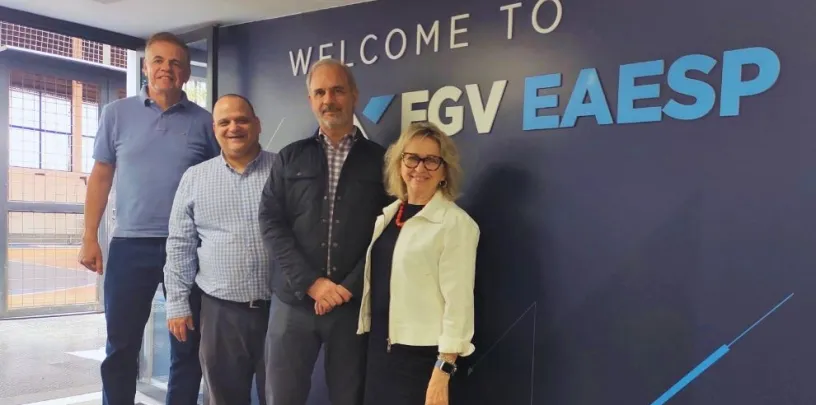
The São Paulo School of Business Administration (FGV EAESP) is launching the Executive in Residence pilot program , which promises to innovate by integrating top executives into the academic environment. João Carlos Brega (CGAE 1986 and CEAG 1987), former president of Whirlpool Latin America, is the first guest of this project, which aims to bring theory closer to practice through collaborations in undergraduate and graduate courses, in addition to contributing to academic research at the Study Centers.
According to Professor Maria José Tonelli , head of the Department of General Administration and Human Resources (ADM), the goal is to create a space for exchange between the job market and academia. "The idea is to promote a constant dialogue between these two worlds, enriching students' learning and professors' research," says Tonelli.
Experience and innovation in the program
Professor Gilberto Sarfati , one of the pioneers of the initiative, emphasizes that the program was designed to extract the best from the collaboration between the market and academia. "We don't know of many programs like this in Brazil. We want to explore how the presence of a high-level executive can impact the development of disciplines and research. We expect to reap great results," comments Sarfati.
With 27 years of experience at Whirlpool, João Carlos Brega brings a wealth of experience in management and leadership in multinational companies. He will be available to teachers and students, sharing his extensive knowledge of the global corporate market and the challenges faced by large organizations.
Check out the interview with João Carlos Brega
What is your relationship with FGV?
Brega: "I have always felt a great deal of gratitude and pride towards FGV. I did my undergraduate and graduate studies here, and now, returning as a collaborator is something very special for me. It will be a unique opportunity to relive my time as a student and contribute directly to the institution that helped me so much. Being able to share my experiences and, at the same time, learn from students and professors is something that excites me a lot."
What did you think of the program's proposal?
Brega: "The proposal is excellent! The combination of theory and practice accelerates development and prepares students to face the job market in a more competitive manner. FGV trains leaders and I am very excited about the opportunity to contribute to the training of future leaders. I believe it will be a rich exchange of learning for everyone involved."
What specific topics do you intend to address?
Brega: "Leadership will undoubtedly be a strong topic. The balance between the short and long term is crucial in any management. I will also address talent retention and how companies can adapt to rapid market changes. Today, there is a lot of talk about how to deal with challenges and some inequalities that the world presents to you. I intend to bring practical examples, situations that I have experienced, challenges that I have faced and how I sought to resolve them. Each situation is unique, so the important thing is to have the right tools to assess and act accordingly."
How do you see the market evolving with new technologies?
Brega: "Disruptive technologies are transforming the market at an exponential speed. Companies need to adapt quickly, otherwise they risk becoming obsolete. I intend to bring this perspective to the discussions: the importance of understanding the sector in which you operate beyond the product you manufacture. If you think that you manufacture refrigerators, for example, you may be limiting yourself. You need to see that you are in the food preservation market and, from there, invest in innovations that truly add value."
What is the role of innovation in large companies?
Brega: "Innovation is taking risks. Out of every thousand initiatives, 990 may fail, but the 10 that succeed need to compensate for all the others. However, it is essential to create a culture where failure is not punished, because if only success is recognized, no one will want to take risks. I want to bring this vision to the program: innovation requires courage and a mindset open to error."
How do you see leadership in today's corporations?
Brega: "Leading by example is essential. When I started my career, leadership was often exercised by force or necessity. Today, leading by example is essential. If you don't practice what you preach, you lose the trust of your team. Communication has also evolved a lot — today, companies are more open and leaders are more approachable. This brings great opportunities, but also challenges, since a communication error can be devastating for the company."
What advice would you give to FGV students?
Brega: "The FGV degree certainly opens doors, but success depends on your competence and dedication. Furthermore, do not confuse “being” with “being”. “Being” in a position does not mean “being” that position, it will not last forever or be part of you. Always maintain ethics and be clear about where you want to go in your career, you are the one who manages it. Lastly, a career is a marathon. A stadium marathon, with 40 laps. Whoever is in the lead in the first or second lap often will not win. Therefore, persistence, consistency, growth and ethics are fundamental to a successful career path.”
About João Carlos Brega
João Carlos Brega is the former Chairman of the Board of Whirlpool SA and Executive Vice President of Whirlpool Corporation, with extensive international experience. Throughout his career, he has held prominent positions, including President of Whirlpool in Latin America, Canada and Mexico, in addition to leading Embraco, the company’s compressor unit. In Brazil, he served as Director of Finance, Information Technology, Strategic Planning and Market Relations at Whirlpool. He is currently Vice Chairman of the Board of Directors of AACD and an independent member of the Board of Directors of São Martinho SA. Brega holds a degree in Business Administration from FGV and is certified as an “Experienced Board Member” by the Brazilian Institute of Corporate Governance (IBGC).
The program
Executive in Residence is a pioneering initiative by the Department of General Administration and Human Resources at FGV EAESP. The program allows experienced executives like João Carlos Brega to collaborate directly with professors and researchers, bringing a practical view of corporations into the classroom and academic projects.
To learn more about FGV EAESP, visit the website.