Knowledge Forum brings together guests to discuss the ESG agenda in organizations
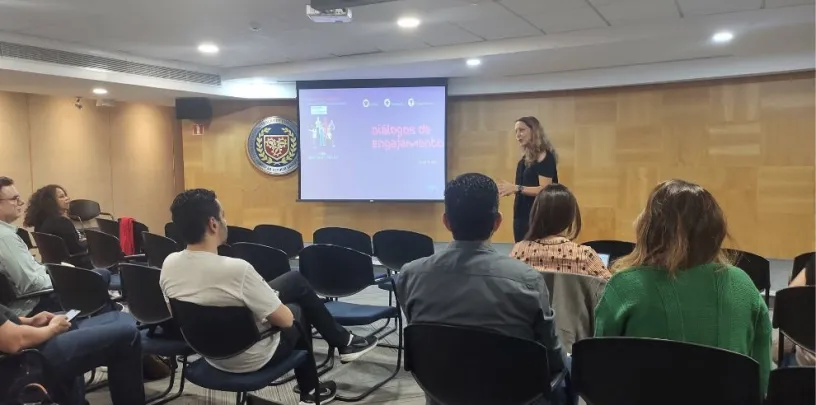
The Professional Master's in Administration program at the São Paulo School of Business Administration (FGV EAESP) held the second edition of the Knowledge Forum discipline. The objective of the initiative is to unite the frontier learning produced in academia with everyday life in the market. To this end, guests from different spheres present their challenges and solutions around the theme “The ESG Agenda in Organizations” to the course students, in São Paulo, on December 8th and 9th. Under the supervision and organization of the program coordinator, Professor Paul Ferreira, it was possible to explore each letter of the ESG acronym with real and current cases, in addition to a literature review in the area.
The social sphere was highlighted by guests Edise Toreta, Head of HR Latam at the Merck Group, and Renata Rivetti, corporate happiness specialist at Reconnect. Edise presented a case from Merck's Engagement Dialogues as a way to develop an employee's sense of purpose and belonging. According to her, it is necessary to have individual initiatives in the company for personal development and a better experience in addition to general corporate campaigns. Therefore, truly getting to know each person who works with you is the first step towards more efficient social actions.
“We contributed to the training of many leaders and how we can transform a company's culture and implement ESG in a way that really has an impact and puts people first. How much do you truly listen to human beings and each person’s needs?”, comments Edise Toreta.
Renata Rivetti addressed the four-day work week project in Brazil and brought some research data on how productivity is very low and demotivation is very high.
According to the specialist in corporate happiness, it is necessary to start developing new ways of working based on the new needs and realities of the 21st century employee, after all, the five days a week/8 hours a day was an invention of Henry Ford in 1926: “The Today's professional wants to find purpose and happiness in their work, and it is necessary to redesign time, work and relationships. New tools and formats need to be implemented, increasingly personalized to the different realities of employees. What I feel today is that we have terrible indicators in several aspects, low engagement, low productivity, very poor mental health, high rates of burnout and anxiety. And the great truth is that the world of work needs change. How can we understand that we have to be protagonists of this construction, of a new way of working. May we discuss ESG issues, diversity and inclusion, a week with more productivity and more mental health.”
After the lectures, a productive chat involved Carolina Pecorari, executive manager of Sustainability and ESG at Ultragás, and Juliana Agostino, consultant and investor in Sustainability and former FGV student, who also brought their professional trajectories and business cases to show how the Environment (E) agenda must be incorporated with the company's strategies and how connections between areas can be made for ESG to generate value and meaning in the corporation. According to Juliana, “talking about sustainability to people who don't necessarily work with it is the most important thing, because you can spread this knowledge, be an influencer so that other people are more aware of the topic. Furthermore, my tip is: study. It’s a topic with so much development – technological, regulatory – that you need to stop and dedicate yourself a little more to learning, otherwise you end up with very superficial knowledge.”
Carolina, on the other hand, showed that “talking about the topic to people who are not used to it and demystifying some concepts, showing that, in fact, sustainability is much more part of their daily lives than they imagine. This way we will guarantee precisely this transition, which is to make sustainability inherent in decision-making”.
Furthermore, to discuss Governance (G), FGV professor Fernando Domingos brought cases of government contracts covering the Sustainable Development Goals in other countries to discuss their feasibility, solutions and commitments in ESG investment. According to the professor, giving the spotlight to the topic without thinking about the entire external system that surrounds it is not the solution.
To conclude the event, the students listened to a lecture by Cristiana Pereira, an associate at IBGC – Brazilian Institute of Corporate Governance, in which she presented the sixth edition of the Code of Best Corporate Governance Practices. This set of practices and principles tends to guide some emerging agendas and, as Cristiana explained, the new edition is intended to be less prescriptive and more inclusive.
“IBGC has always focused on ESG, but we realized that more emphasis needs to be placed on it. The initiative came from a trend observed in other countries, but beyond that, it is what the Institute believes. Organizations are embedded in society and the environment and today it is no longer enough to simply make a donation, preserve or offset an emission. Organizations must be part of the country's environmental, climate and social solution. Increasingly, organizations have to be more consistently and intensely engaged in this discussion”, says Cristiana.
At the end of the two-day event, students discussed among themselves and reflected on what the ESG Agenda is like in their corporations and daily lives and how they can contribute more to this agenda.
Find out more about the Professional Master's in Administration on the website .