Em andamento
Digital transformation
1. CONTEXT
Information Technology (IT) has always been evolving since its inception, both in terms of its supply and its use by organizations. This evolution presents clear cycles of digital innovation that lead to cycles of innovation in digital products and services, which in turn lead to cycles of innovation in their use by organizations.
The evolution and cycles of digital innovation have led to the current scenario in which various technologies have emerged and are expanding and consolidating, with great potential for organizations and individuals. The more skeptical view may see it as just another wave of promises, while the more optimistic view sees it as a new cycle of innovation, both digital and in terms of business and social processes.
It is certainly not appropriate to use technology just for the sake of technology itself, but rather to use it for the benefit of organizations and individuals, of society as a whole. In this way, technology has evolved and innovated to meet the needs of society as it has evolved. In social and business environments, evolution has fostered, demanded and made use of the evolution of technology.
In this context, this research project addresses Digital Transformation as the application of digital innovation to generate value for society and business.
2. DIGITAL TRANSFORMATION
Digital Transformation can be understood as the use of digital innovation to achieve something new, different and better. At the limit, it can be a new use of technology that has already been assimilated in an innovative way. The focus can be on processes, products, business models and internal and external relationships.
Digital Innovation includes a new technology available to be assimilated by society and companies, an evolution of a previous one or a completely new one. Assimilation takes into account the situation of each company or environment and depends on the characteristics and requirements of each technology.
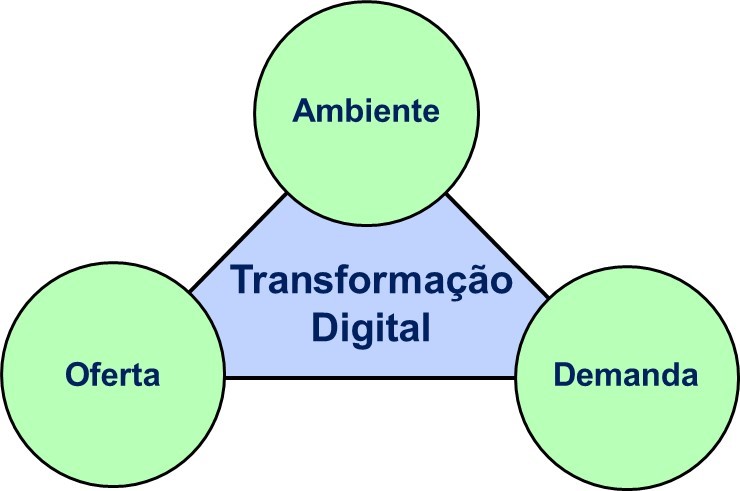
With this breadth, Digital Transformation must also be understood broadly, especially considering the current and future supply of technology, the demand for its functionalities and the very environment in which it is inserted. Figure 1 shows this composition of dimensions, which must be balanced and coherent, otherwise the development, consolidation and implementation of Digital Transformation will be compromised.

This broad vision makes it possible to understand the complexity inherent in Digital Transformation, while at the same time helping to structure studies and research in this area.
2.1. Supply, Demand and Environment
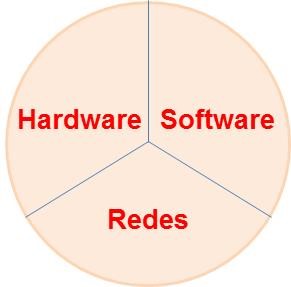
Digital innovation can be represented by the supply of hardware, software, networks and associated services, which must be studied in terms of current availability and uptake, as well as trends, which are influenced by and influence demand (Albertin; Albertin, 20171).

The Digital Transformation will occur with the assimilation of digital innovations offered directly or indirectly to society and organizations.
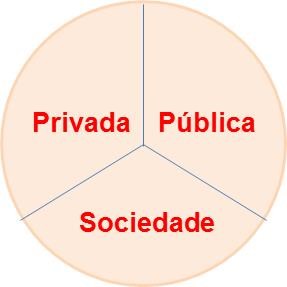
The demand for digital innovation, which will define its acceptance, assimilation and use, comes and will come from the private sector and its companies; from the public sector and its initiatives at municipal, state and national level; and from society, especially its individuals and relationships. Figure 3 shows this composition of demand.

The demand for Digital Transformation will be defined by the set of needs of these components, which will be related to each other.
Digital Transformation will take place in an environment that will influence and be influenced by its forces, behaviors and roles, including government, private initiative, society and the economy. Figure 4 shows this composition of the environment.

The government is part of the environment, taking on roles such as regulator, promoter and demander. Private initiative will act in the Digital Transformation environment to meet its characteristics and interests. Society must be taken care of, be prepared, be respected and participate in the Digital Transformation environment. The economy, with its strengths, can guarantee and restrict initiatives in this Digital Transformation environment.
2.2 Vertical and Horizontal
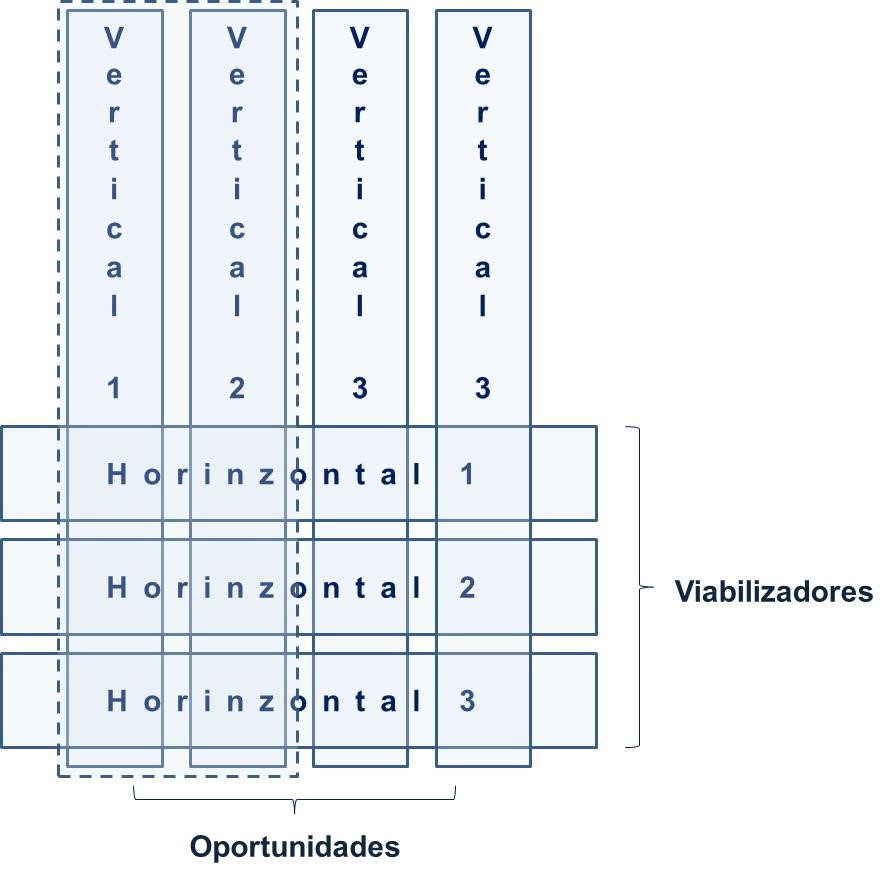
The breadth of Digital Transformation requires that it be studied considering at least two dimensions: vertical, sectors of the economy, areas and specific initiatives that can have some value added by Digital Transformation; and horizontal, aspects that are related to some extent to all the digital products and services available to all sectors for carrying out Digital Transformation. Figure 5 shows these dimensions.

Of course, respecting these dimensions does not mean that the relationship between the verticals and horizontals, as well as between the dimensions, should not be considered and studied.
The verticals represent the Opportunities and the horizontals the Enablers of Digital Transformation.
3. Dimensions of the use of information technology
Organizations must define their guidelines, strategies and operations, considering the context in which they operate, taking advantage of the opportunities and overcoming the challenges presented. In this scenario, IT is one of the most important organizational components and has permeated practically all internal and external actions. The use of IT can be better understood using the Dimensions of Information Technology Use (Albertin; Albertin, 2016), shown in figure 6.

IT use must also consider the context, defined in this article by the drivers of organizational responses and IT use, including market, organizational, individual and technology pressures. The value that IT can add to the organization is directly related to the quality of the study of these drivers.
The use of IT will also be determined by the vision and value that this technology has for the company, as well as the various IT applications that are available to organizations: infrastructure, transactional, informational and strategic (Weill and Broadbent, 19982), with their respective benefits of cost reduction, increased productivity, improved quality, the possibility of flexibility and enabling innovation. These applications have different levels of business reconfiguration, depending on the need defined by the drivers. At the highest level, IT can make a definitive contribution to the creation of new business models.
Organizations depend on certain requirements to ensure their success, which can be achieved through the use of IT. The use of IT offers business benefits that include cost, productivity, quality, flexibility and innovation, and each use has its own composition of these benefits. The challenge for organizations is to determine as precisely as possible which ones are actually offered and desired, as this identification will be the basis for confirming these benefits in business performance.
Business performance has certainly been affected by the use of IT, but the way in which this occurs depends on the perspective used in the relationship between the organization and IT, which can range from considering IT as a simple consequence of organizational guidelines, to IT as a facilitator and provider of business innovations. These perspectives determine the value that is given to and expected from the use of IT. Business performance includes four perspectives: financial, customer, internal processes and learning and growth (Kaplan; Norton, 19963).
IT governance can be understood as the authority and responsibility for decisions regarding the use of IT. IT management, with its planning, organizing, directing and controlling processes, aims to ensure that efforts to use IT are carried out successfully, from defining it with strategic alignment, influenced by the context, to measuring its impact on business performance.
IT management should not only be carried out by IT executives, but is an organizational responsibility in which business executives play a decisive role in its success.
The dimensions of IT use and their relationships produce internal and external effects on organizations, which means that they also influence the context and its drivers, altering them and being altered by them.
4. Dimensions of information technology use applied to the Internet of Things
The use of Digital Transformation can then be considered an IT use and therefore related to the Dimensions of Information Technology Use. In this way, the two sets of dimensions, Digital Transformation and IT, are related, as shown in figure 7.

The use of Digital Transformation is linked to the company's external environment (Environment and Market), its internal context (Demand and Organization and Individual) and the technology itself (Supply and IT).
The demand for Digital Transformation can be understood as a use of IT in companies and is therefore related to infrastructure(Internet of Things, cloud computing, bring your own device, etc.), transactional (augmented reality, robots, etc.), informational(artificial intelligence, machine learning, etc.) and strategic (applications that support and enable company strategies).
The benefits of using Digital Transformation are classified into cost, productivity, quality, flexibility and innovation; as is the use of IT more generally. These benefits should affect business performance.
5. DIGITAL TRANSFORMATION Project
The Digital Transformation project focuses on the current situation and trends, considering the application of digital innovation to generate value for society and business. In this way, digital innovation itself is a given context and not the focus of the study.
Digital Transformation presents challenges and opportunities. The supply of technology, demand and the environment in which it will be inserted must be integrated and synergistic to ensure its evolution.
Digital Transformation offers opportunities for social and economic gains in various sectors of society and the economy. These sectors can be understood as verticals for using this technology.
At the same time, it requires appropriate treatment of aspects that can facilitate or hinder, or even make impossible, its development, consolidation and use. These aspects can be understood as horizontal aspects of Digital Transformation.
The components of society and the economy that are related to the verticals and horizontals can also be understood as dimensions of Digital Transformation.
The research question that follows from this argument is: How should the potential of Digital Transformation be harnessed, considering its opportunities and challenges?
5.1. General Objective and Specific Objectives
The main objective of the Digital Transformation Project is to consolidate its concept and dimensions, identify the benefits and challenges, and define indicators for its implementation.
The specific objectives are defined as follows:
Review the concept and scope of Digital Transformation and its dimensions.
Identify the opportunities for Digital Transformation to generate value for society and organizations.
To identify the challenges to the effective realization of Digital Transformation and how to deal with them.
Develop social and business indicators to measure the level of Digital Transformation in society and organizations.
5.2 Expected results and contributions
The use of IT is widespread and intense both in the organizational environment and in society, with clear growth at all socio-economic levels and permeating all business and social processes. The current focus is Digital Transformation, to do something new, different and better.
In this scenario, it is necessary to study and research the various aspects that can facilitate, hinder, prevent and enable the expansion, consolidation and use of Digital Transformation.
The expected results include a review of the concept of Digital Transformation, an understanding of its identification and scope, the identification of economic sectors with potential for its realization, the identification of process changes brought about, necessary or made possible by Digital Transformation, and the benefits obtained or expected from its use.
The results also include the knowledge systematized and created with the research project, in its various phases, as well as the training of human resources, including the postgraduate students who will take part.
The academic and scientific contribution is the theoretical and empirical foundation to serve as a basis for studies and research into Digital Transformation. The contribution for companies includes knowledge linked to practice as a subsidy for their strategies for using this technology.
5.2.1 Dissemination of results
This project will disseminate its results by:
participating in congresses and submitting papers on the project's results;
submitting articles to journals presenting the results of the project; and
publishing the main results and working papers on the FGVcia website.
5.3. Integrated Projects
This project includes the following Integrated Projects:
Theoretical Rationale;
Digital Transformation Case Studies; and
Development of Digital Transformation indicators.
1ALBERTIN, A. L.; ALBERTIN, R. M. M. The Internet of Things will go far beyond things. GVexecutivo, ISSN 1806-8979, vol. 16, n. 2, pp. 13-17, Mar/Apr 2017
2WEILL, P.; BROADBENT, M. Leavering the new infrastruture: how market leaders capitalize on IT. Boston: Harvard Business School Press, 1998.
3KAPLAN, R. S. and NORTON, D. P. The Balanced Scorecard: Translating Strategy into Action. Boston: Harvard Business School Press, 1996.

1. Contexto
A Tecnologia de Informação (TI) sempre esteve em evolução desde o seu surgimento, tanto na sua oferta como no seu uso pelas organizações. Esta evolução apresenta ciclos claros de inovação digital que levam a ciclos de inovação de produtos e serviços digitais, que por sua vez permitem ciclos de inovação de seu uso pelas organizações.
As evoluções e ciclos de inovação digital levaram ao cenário atual no qual várias tecnologias surgiram e estão em expansão e consolidação, com grande potencial para as organizações e indivíduos. A visão mais cética pode considerar como mais uma onda de promessas, a visão mais otimista a considera como um novo ciclo de inovação, tanto digital como de processos de negócio e sociais.
Certamente, não é adequado o uso de tecnologia justificado apenas pela própria tecnologia, mas sim seu uso em benefício das organizações e dos indivíduos, da sociedade como um todo. Desta forma, a tecnologia teve sua evolução e inovação para atender as necessidades da sociedade na sua própria evolução. Nos ambientes sociais e de negócios, a evolução propiciou, exigiu e se utilizou da evolução da tecnologia.
Neste contexto, este projeto de pesquisa trata Transformação Digital como a aplicação de inovação digital para gerar valor para a sociedade e para os negócios.
2. Transformação Digital
Transformação Digital pode ser entendida como o uso de inovação digital para realizar algo novo, diferente e melhor. No limite, pode ser um novo uso de tecnologia já assimilada de forma inovadora. O foco pode ser processo, produto, modelo de negócio e relacionamento interno e externo.
Inovação Digital inclui uma nova tecnologia disponível para ser assimilada pela sociedade e empresas, evolução de uma anterior ou totalmente nova. A assimilação considera a situação de cada empresa ou ambiente e depende das características e requisitos de cada tecnologia.
Com esta amplitude, Transformação Digital tem que ser entendida também de forma ampla, em especial considerando a oferta de tecnologia atual e futura, a demanda por suas funcionalidades e o próprio ambiente onde ela está inserida. A figura 1 apresenta esta composição de dimensões que deve ter equilíbrio e coerência, sob pena de comprometer o desenvolvimento, consolidação e efetivação da Transformação Digital.
Esta visão ampla permite entender a complexidade inerente a Transformação Digital ao mesmo tempo que contribui para a estruturação dos estudos e pesquisa nesta área.
2.1. Oferta, Demanda e Ambiente
A inovação digital pode ser representada pela Oferta de hardware, software, redes e serviços associados deve ser estudada na disponibilidade e assimilação atual, bem como pelas tendências, que são influenciadas e influenciam a demanda (Albertin; Albertin, 20171) A figura 2.2 apresenta esta composição da oferta.
A Transformação Digital ocorrerá com a assimilação das inovações digitais ofertadas direta ou indiretamente para a sociedade e organizações.
A demanda por inovação digital, que definirá a sua aceitação, assimilação e utilização, vem e virá da iniciativa privada e suas empresas; da iniciativa pública e suas iniciativas nos níveis municipal, estadual e nacional; e da sociedade, em especial dos seus indivíduos e relações. A figura 3 apresenta esta composição da demanda.
A demanda por Transformação Digital será definida pelo conjunto de necessidades destes seus componentes, que estarão relacionados entre si.
Transformação Digital acontecerá num ambiente que influenciará e será influenciado nas suas forças, comportamentos e papéis, incluindo governo, iniciativa privada, sociedade e economia. A figura 4 apresenta esta composição do ambiente.
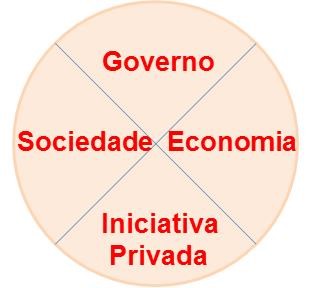
O governo faz parte do ambiente assumindo papéis tais como regulador, incentivador e demandante. A iniciativa privada, para atender suas características e seus interesses, atuará no ambiente de Transformação Digital. A sociedade deve ser atendida, estar preparada, ser respeitada e participar no ambiente de Transformação Digital. A economia, com suas forças, pode garantir e restringir as iniciativas neste ambiente de Transformação Digital.
2.2. Verticais e Horizontais
A amplitude de Transformação Digital exige que esta seja estudada considerando pelo menos duas dimensões: vertical, setores da economia, áreas e iniciativas específicas que podem ter algum valor adicionado pela Transformação Digital; e horizontal, aspectos que estão relacionados em alguma medida com todos os produtos e serviços digitais disponíveis para todos os setores para a realização da Transformação Digital. A figura 5 apresenta estas dimensões.
Certamente, respeitar estas dimensões não significa que não deve ser considerada e também estudada a relação que existe entre as verticais e as horizontais, bem como entre as dimensões.
As verticais representam as Oportunidades e as horizontais os Viabilizadores da Transformação Digital.
3. Dimensões do uso de tecnologia de informação
As organizações devem definir suas diretrizes, estratégias e operacionalização, considerando o contexto em que atuam, aproveitando as oportunidades e vencendo os desafios apresentados. Neste cenário, a TI é um dos componentes organizacionais mais importantes e tem permeado praticamente todas as ações internas e externas. O uso de TI pode ser melhor entendido com o uso das Dimensões do Uso de Tecnologia de Informação (Albertin; Albertin, 2016), apresentadas na figura 6.
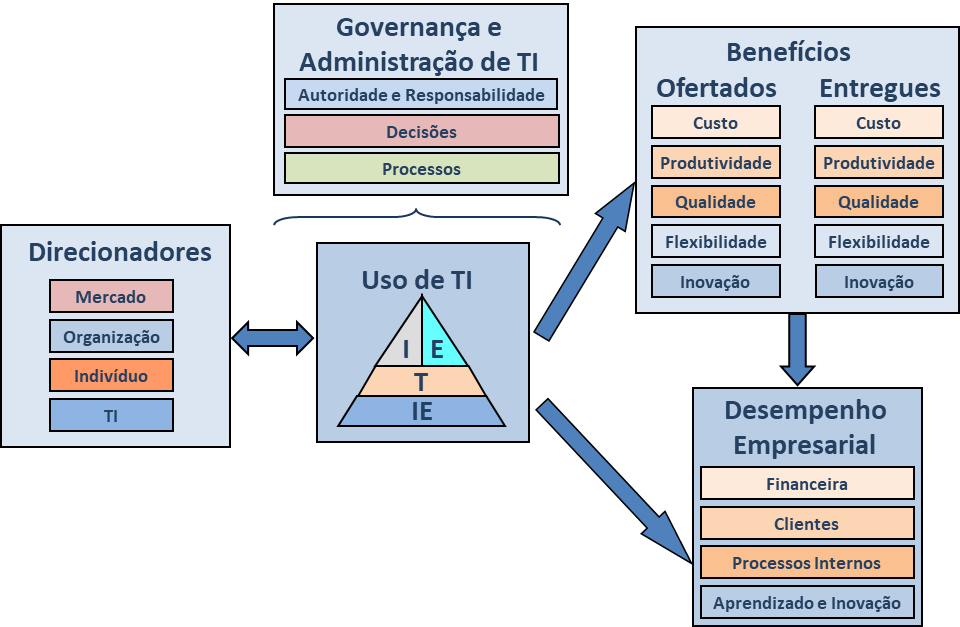
O uso de TI também deve considerar o contexto, definido neste artigo pelos direcionadores das respostas organizacionais e do uso de TI, incluindo as pressões de mercado, organizacionais, de indivíduo e da própria tecnologia. O valor que a TI poderá agregar à organização está diretamente relacionado com a qualidade do estudo destes direcionadores.
O uso de TI também será determinado pela visão e o valor que esta tecnologia tem para a empresa, assim como pelas várias aplicações de TI que estão à disposição das organizações: infraestrutura, transacional, informacional e estratégico (Weill e Broadbent, 19982), com seus respectivos benefícios de redução de custo, aumento de produtividade, melhoria da qualidade, possibilidade de flexibilidade e viabilização de inovação. Estas aplicações têm níveis diferentes de reconfiguração de negócio, dependendo da necessidade definida pelos direcionadores. No nível mais elevado, a TI pode contribuir de forma definitiva para a criação de novos modelos de negócio.
As organizações dependem de certos requisitos para garantirem seu sucesso, que podem ser alcançados com a utilização de TI. O uso de TI oferece benefícios para os negócios que incluem custo, produtividade, qualidade, flexibilidade e inovação, e cada uso tem uma composição própria destes benefícios. O desafio das organizações é determinar o mais precisamente possível quais os realmente ofertados e desejados, pois essa identificação será a base para a confirmação desses benefícios no desempenho empresarial.
O desempenho empresarial certamente tem sido afetado pelo uso de TI, porém a maneira que isto ocorre depende da perspectiva usada na relação entre a organização e a TI, que pode ser desde a consideração de TI como simples decorrência das diretrizes organizacionais, até a TI como facilitadora e fornecedora de inovações de negócio. Estas perspectivas determinam o valor que é dado e que se espera do uso de TI. O desempenho empresarial inclui quatro perspectivas: financeira, de clientes, de processos internos e de aprendizado e crescimento (Kaplan; Norton, 19963).
A governança de TI pode ser entendida como a autoridade e responsabilidade pelas decisões referentes ao uso de TI. A administração de TI, com seus processos de planejamento, organização, direção e controle, tem como objetivo garantir a realização bem-sucedida dos esforços para o uso de TI, desde sua definição com o alinhamento estratégico, influenciado pelo contexto, até a mensuração de seus impactos no desempenho empresarial.
A administração de TI não deve ser realizada apenas pelos executivos dessa área, mas é uma responsabilidade organizacional da qual os executivos de negócio têm participação decisiva em seu sucesso.
As dimensões do uso de TI e suas relações produzem efeitos internos e externos nas organizações, o que significa que elas também influenciam o contexto e seus direcionadores, alterando-os e sendo alteradas por eles.
4. Dimensões do uso de tecnologia de informação aplicadas à internet das coisas
O uso de Transformação Digital pode então ser considerado como um uso de TI e, portanto, relacionado com as Dimensões do Uso de Tecnologia de Informação. Desta forma, relaciona-se os dois conjuntos de dimensões, de Transformação Digital e de TI, conforme apresentado na figura 7.
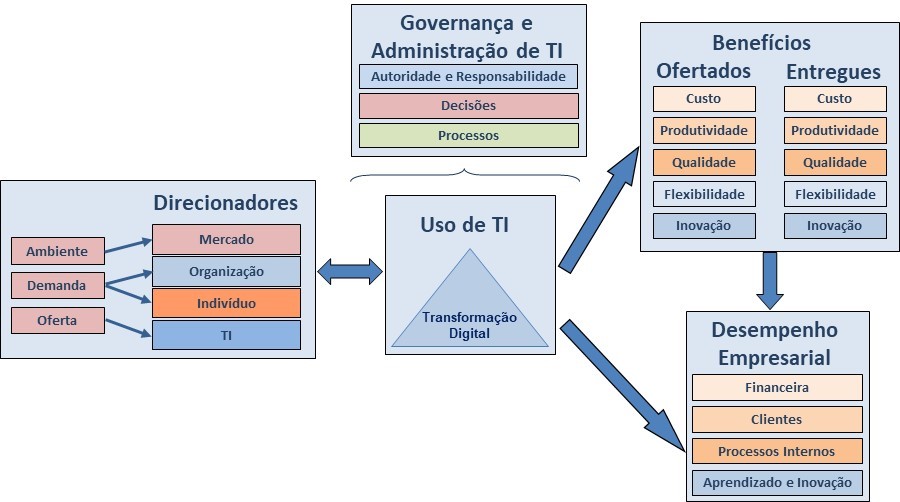
O uso de Transformação Digital está vinculado com o ambiente externo da empresa (Ambiente e Mercado), seu contexto interno (Demanda e Organização e Indivíduo) e a própria tecnologia (Oferta e TI).
A demanda por Transformação Digital pode ser entendida como um uso de TI nas empresas e, portanto, está relacionada com infraestrutura (Internet of Things, cloud computing, bring your own device, etc.), transacional (realidade aumentada, robôs etc.), informacional (artificial intelligence, machine learning etc.) e estratégico (aplicações que suportam e viabilizam as estratégias da empresa).
Os benefícios do uso de Transformação Digital são classificados em custo, produtividade, qualidade, flexibilidade e inovação; como também é o uso de TI de forma mais geral. Estes benefícios devem afetar o desempenho empresarial.
5. Projeto TRANSFORMAÇÃO DIGITAL
O projeto Transformação Digital tem como foco sua situação atual e suas tendências, considerando a aplicação da inovação digitais para gerar valor para a sociedade e para os negócios. Desta forma, a inovação digital em si é um dado do contexto e não o foco do estudo.
A Transformação Digital apresenta desafios e oportunidades. A oferta de tecnologia, a demanda e o ambiente no qual estará inserida devem ter integração e sinergia para garantir a sua evolução.
A Transformação Digital oferece oportunidades de ganhos sociais e econômicos em vários setores da sociedade e da economia. Estes setores podem ser entendidos como verticais de utilização desta tecnologia.
Ao mesmo tempo, exige o tratamento adequado de aspectos que podem facilitar ou dificultar, no limite inviabilizar, seu desenvolvimento, consolidação e utilização. Estes aspectos podem ser entendidos como horizontais da Transformação Digital.
Os componentes da sociedade e da economia que estão relacionados com as verticais e com as horizontais também podem ser entendidos como dimensões da Transformação Digital.
A questão de pesquisa que decorre desta argumentação é: Como deve ser o aproveitamento do potencial da Transformação Digital, considerando suas oportunidades e desafios?
5.1. Objetivo Geral e Objetivos Específicos
O Projeto Transformação Digital tem como objetivo principal consolidar seu conceito e suas dimensões, identificar os benefícios e os desafios, e definir indicadores de sua efetivação.
Os objetivos específicos estão assim definidos:
Revisar o conceito e abrangência da Transformação Digital e suas dimensões.
Identificar as oportunidades da Transformação Digital gerar valor para a sociedade e para as organizações.
Identificar os desafios para a efetiva realização da Transformação Digital e como tratá-los.
Elaborar indicadores sociais e empresariais para medir o nível da Transformação Digital na sociedade e nas organizações.
5.2. Resultados Esperados e Contribuições
O uso de TI é amplo e intenso tanto no ambiente organizacional como na sociedade, com claro crescimento em todos os níveis socioeconômicos e permeando todos os processos de negócio e sociais. O destaque atual é Transformação Digital, para fazer algo novo, diferente e melhor.
Neste cenário, é necessário estudar e pesquisar os vários aspectos que possam facilitar, dificultar, impedir e viabilizar sua expansão, consolidação e utilização da Transformação Digital.
Os resultados esperados incluem a revisão do conceito de Transformação Digital, o entendimento de sua identificação de sua abrangência, a identificação de setores econômicos com potencial para sua realização, a identificação das mudanças de processos provocadas, necessárias ou viabilizadas por Transformação Digital, e os benefícios obtidos ou esperados por esta utilização.
Os resultados também incluem o conhecimento sistematizado e criado com o projeto de pesquisa, nas suas várias fases, assim como a formação de recursos humanos que incluem os alunos de pós-graduação que dele participarão.
A contribuição acadêmica e científica é a fundamentação teórica e empírica para servir de base para estudos e pesquisas sobre Transformação Digital. A contribuição para as empresas inclui o conhecimento vinculado à prática como subsídio para suas estratégias de utilização desta tecnologia.
5.2.1. Divulgação dos Resultados
Este projeto prevê a divulgação dos seus resultados por meio da:
participação em congressos com submissão de trabalhos sobre os resultados do projeto;
submissão de artigos para periódicos apresentando os resultados do projeto; e
divulgação dos principais resultados e working papers no site do FGVcia.
5.3. Projetos Integrados
Este projeto prevê os seguintes Projetos Integrados:
Fundamentação Teórica;
Estudos de Caso de Transformação Digital; e
Elaboração de indicadores de Transformação Digital.
ALBERTIN, A. L.; ALBERTIN, R. M. M. A Internet das Coisas irá muito além das coisas. GVexecutivo, ISSN 1806-8979, vol. 16, n. 2, pp. 13-17, mar/abr 2017
WEILL, P.; BROADBENT, M. Leavering the new infrastruture: how market leaders capitalize on IT. Boston: Harvard Business Scholl Press, 1998.
KAPLAN, R. S. e NORTON, D. P. The Balanced Scorecard: Translating Strategy into Action. Boston: Harvard Business School Press, 1996.