Event highlights the importance of intersectoral cooperation to promote innovation in Brazil
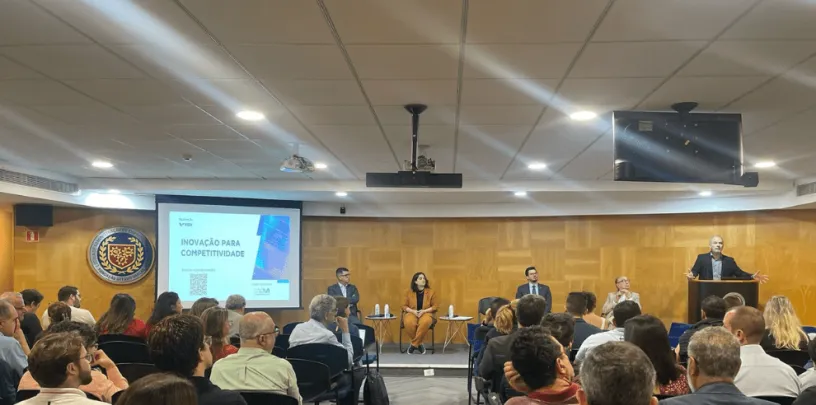
“Innovation is a political, economic and personal choice that society needs to make,” declared Marcos Cintra, vice president of Fundação Getulio Vargas, during the opening of the Innovation for Competitiveness event, which took place on March 27, in the Salão Nobre of the São Paulo School of Business Administration (FGV EAESP). On the occasion, experts from industry, companies and startups met with researchers to discuss how to transform research into innovation. During the debates, one conclusion was unanimous: the path to promoting innovation depends on intersectoral cooperation between academics and representatives of government and industry.
According to the Web of Science platform, Brazil is the 13th country among those that produce the most scientific articles in the world, but according to the Global Innovation Index, Brazil ranks 50th when it comes to innovation. “This indicates that we are not making the right choices to develop the potential we have in order to solve the country's pressing problems using science and technology,” said Cintra.
The vice president shared the opening table with the manager of Ecological Transition and Innovation of the National Confederation of Industry (CNI) Alessandro Rizzato; the director of Innovation and Institutional Relations of the Brazilian Company for Industrial Research and Innovation (Embrapii), Igor Nazareth; the director of FGV Ventures, Luciana Cualheta; and the vice-director of FGV EAESP, Tales Andreassi.
Intersectoral cooperation to promote innovation
During the first round of presentations, Rizzato introduced one of CNI's main products today: the Business Mobilization for Innovation (MEI). "We propose to unite the three main players in the innovation ecosystem - industry, academia and government - all with the same vision in pursuit of a common goal, which is industrial innovation in the country," he said.
The Ecological Transition and Innovation Manager also highlighted that there is an online tool that publicizes all the innovation promotion tools available in the country. This is MEI Tools , which provides information on notices, financing lines, programs, scholarships, partnerships, financial contributions, economic subsidies, project support and much more.
Given the discrepancy between the position in the academic publications index and the implementation of innovation, Embrapii's director of Innovation and Institutional Relations, Igor Nazareth, highlighted that Embrapii emerged precisely in this context, to address how to use scientific knowledge to generate innovative products and services for companies.
“We do this (transform scientific knowledge into innovation) through the 93 Embrapii units that operate in all sectors of the economy - such as chemistry, biotechnology, nanotechnology, Artificial Intelligence, among others - taking the best that exists in academia and making it available to companies”, explained Nazareth.
According to the director, Embrapii is the materialization of the triple helix, bringing together government, academia and companies, with a total of 15,564 employees developing projects to meet demands from the Brazilian private sector.
“Any company, at any time, can seek out an Embrapii unit and demand an innovation. Based on this demand, a project will be structured to present the company with the necessary investments and the appropriate steps for developing this project,” he explained.
The director presented two projects that exemplify how academia can solve problems for Brazilian companies. The first is the Machine Learning Using Synthetic Images of Automotive Vehicles project, developed by the Federal University of Goiás (UFG) for the company Cilia Tecnologia, whose objective is to develop an AI methodology that generates estimates after car accidents, based on photos of the damage to the vehicles, to calculate the costs and repairs that will need to be made. Learn more about this innovation.
The other project is GuarAI: Research and Development of a Visual Product Inspection System Using AI and IoT. Developed at the Metrópole Digital unit of the Federal University of Rio Grande do Norte (UFRN) for the company Guararapes Confecções S/A, this project aims to develop an inspection system for companies in the fabric industry, using AI and Internet of Things (IOT) techniques to detect flaws in rolls of knitwear or fabrics, which allows companies to be informed about possible flaws in the process and thus save time and production, avoiding rework. Learn more about this project.
Factors preventing Brazil from increasing innovation rates
The vice-director of FGV Eaesp, Tales Andreassi, pointed out 5 reasons why Brazil is so uncompetitive in relation to technological innovation and cannot reach the most developed countries in innovation.
“The first is the low investment in R&D; Brazil invests 1%, while the US invests 3.5% and Korea 4.5%. The second point is that in Brazil most investments come from the public sector, while in other countries they come from the private sector. The third point is the instability of public policies related to R&D; we had a major cut in funding for science and technology in the previous government. The fourth reason is the lack of support for digitalization and Industry 4.0, which causes a major delay in the adoption of artificial intelligence, robotics and the Internet of Things (IOT),” he said.
Furthermore, the professor also pointed out the critical points that need to be worked on for the country to reach a higher standard of innovation. According to Andreassi, low competitiveness due to high taxes, poor infrastructure and functional illiteracy are some crucial points that need to be worked on in order to increase innovation in the country.
FGV Ventures: FGV's business accelerator
The event also provided an opportunity for FGV Ventures director Luciana Cualheta to present the Foundation's accelerator, which is the first university accelerator in the country. The program, which lasts for 4 months, is aimed at startups from all over Brazil, with the goal of training entrepreneurs through workshops taught by professors from the FGV network. In total, 87 startups have already gone through the program in 17 acceleration batches since 2016, totaling more than R$600 million in valuation and R$150 million in investment.
To participate in the program, startups must have an MVP validated with real customers, that is, a first functional version of the product. “The business values must also be socially and environmentally responsible, with diverse and complementary teams that think not only about financial gains, but also about the externalities caused by the business,” he said. Learn more about FGV Ventures.
The event also featured technical panels on innovation in sustainability, innovation in the automotive sector and innovation in health. Also participating in the debates were researchers from FGV and the University of New South Wales (UNSW); representatives from Braskem, the Technological Institute of Aeronautics (ITA), and the Brazilian Association of Automotive Engineering (AEA); entrepreneurs from the startups Carristas, WILU, and IWASTE; as well as representatives from the company Nintx, the accelerator Inova Unicamp, and the Hospital Sírio-Libanês.
Watch the full event: