Professional Doctorate in Management Master Class discusses climate finance and sustainability
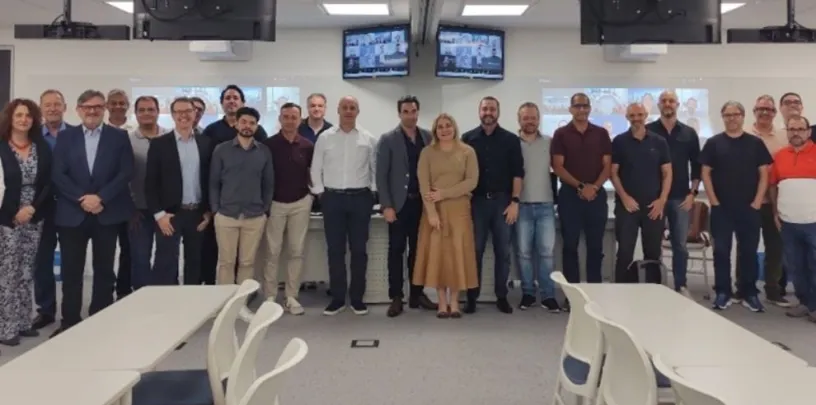
The Professional Doctorate in Administration (DPA) of the School of Business Administration of São Paulo (FGV EAESP) began its activities for the class of 2025 with an inaugural class that highlighted frontier themes: socio-environmental risks and the transition to a more sustainable economy. The occasion had the contributions of renowned experts, such as Enrico Dalla Riva, a specialist in socio-environmental risks at the Central Bank, and Talita Pinto, coordinator of FGV's Bioeconomy Observatory.
Enrico Dalla Riva: the urgency of climate finance
With more than 20 years of experience at the Central Bank, Enrico Dalla Riva brought a pragmatic view on the evolution of the concept of socio-environmental risks in the financial system. In his lecture "Climate Finance", he highlighted the importance of directing resources to mitigate climate change. "We have invested only a third of what is needed to combat climate change. The cost of doing nothing is much higher than investing in adaptation, resources and prevention," he said.
Enrico also addressed concrete examples, such as the recent floods in Rio Grande do Sul, to illustrate the impact of the lack of preparation and adaptation. According to him, the financial sector is adapting, with regulatory advances and shareholder engagement. However, it is necessary for corporate leaders to take responsibility for incorporating these risks into the day-to-day life of organizations. "Organizations need to understand their share of responsibility and not wait for regulation or external actions," he emphasized.
Talita Pinto: the financial sector as a driver of decarbonization
Talita Pinto highlighted the crucial role of financial institutions in achieving global climate goals, such as carbon neutrality by 2050. In his lecture, he addressed initiatives such as the Net Zero Banking Alliance, which commits financial institutions to align their lending and investment activities with global climate goals.
The coordinator of FGV's Bioeconomy Observatory also highlighted Brazil's opportunities in this scenario. With an agribusiness that represents about a quarter of the national GDP, Talita argued that it is essential to value the country's green assets and create financial incentives to foster a more sustainable economy. "Brazil is a great mix of inequality and environmental wealth. We need to think of financing as a possibility to generate incentives for sustainable development," he explained.
The connection between academia and the market
Both experts reinforced FGV's role as a link between academia and the market. Talita highlighted the importance of initiatives that bring the two universes closer together: "FGV connects the market, which seeks practical solutions, to academia, which offers grounded analysis and sustainable trajectories."
Testimonials and welcome
We welcome the DPA 2025 class and celebrate the beginning of this new academic journey. However, we cannot fail to notice that this class has only one woman, which highlights an important challenge: to expand diversity in our program. We recognize the need to make DPA more inclusive and representative, and we are committed to initiatives that move forward in this regard. One of them is the WDBA group, formed by doctors and doctoral students of the program, which promotes support, networking and the appreciation of female representation in our institution and in the market. In addition, there is the DBA Club, an initiative of the FGV EAESP Alumni network for the alumni of the program.
After the lectures, the new students had the opportunity to hear testimonies from DPA alumni and doctoral students, such as Mel Girão, Sandro Benelli and Maximiliano Carlomagno, who shared their experiences and the impacts of the doctorate on their professional trajectories. The meeting ended with a welcome from the new course coordinator, Professor Paul Ferreira, who reinforced DPA's commitment to training leaders capable of facing contemporary challenges with an integrated vision between science, market and sustainability.