Artificial intelligence and strategy in focus at the Knowledge Forum 2025
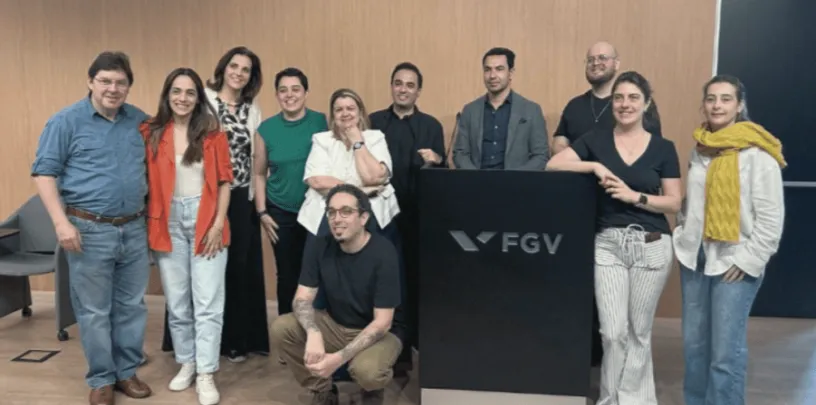
FGV EAESP held another edition of the Knowledge Forum , a central discipline of the Professional Master's in Administration (MPA) and a space for articulation between academic knowledge and organizational practice. In 2025, the meeting's theme was "AI & Strategy: mastering decision-making in the digital age," continuing a trajectory that has already addressed the Future of Work, the ESG Agenda, and Strategic Innovation in previous years.
Coordinated by Professor Paul Ferreira, the Forum reinforced the concept of the manager-scientist, a profile that guides the MPA and combines analytical rigor, use of evidence, methods, and technology to generate real impact in organizations. This edition featured an unprecedented partnership with Resorts Brasil, which presented a real-world challenge involving clients, processes, and supply chain. Students developed solutions based on artificial intelligence and competed for an experience at the chain's resorts in the country.
Over two days, executives, researchers, and innovation leaders shared complementary perspectives on the role of AI in decision-making, operational efficiency, creativity, and customer experience. In his opening remarks, Carlos Azevedo, expert associate partner of AI & Data Science at Bain & Company, highlighted how more powerful, multimodal, and accessible models are transforming the logic of digital consumption, with advancements in conversational commerce and personalization at scale. Following him, Professor Eduardo Francisco Rezende emphasized that competitive organizations are those capable of transforming data into strategic advantage through solid foundations and continuous experimentation.
The debate moved on to the risks and limitations of the uncritical use of technology. Professor Gilberto Sarfati presented reflections from his book Superdecision and warned about the intensification of cognitive laziness in highly automated environments. Marcelo Suzuki, global business executive at Siemens, reinforced that operating tools is not enough without clarity about the strategic problem, reminding that the illusion of certainty can amplify risks when AI is used on autopilot.
The relationship between technology, creativity, and consumer behavior was also central to the discussions. Isabella Milano, an MPA graduate and product marketing manager at Google, presented her research on creativity in AI-mediated environments and the role of team training. Claudia Carneiro, Google's search product lead for Brazil, addressed the evolution of search, now more intelligent, multimodal, and contextual, with direct impacts on purchase journeys. In healthcare, Alex Julian, CIO of Hospital Sírio-Libanês, presented applications ranging from predictive medical records to intelligent scheduling. Cíntia Barcelos, CTO of Bradesco, highlighted the importance of integrated data, ethics, and governance for AI to generate effective impact, in addition to presenting the evolution of the virtual assistant BIA. Cristina Cestari, CIO of Volkswagen, showed how technology captures tacit knowledge and creates a competitive advantage in traditional companies, while Fernando Vitti, founder and CEO of Nexforce, concluded the day by presenting Revenue Operations as a response to the structural inefficiency of organizations.
For the students, the format used was one of the highlights of the MPA. According to one participant, seeing different business perspectives and working on a real-world challenge made the learning more concrete and engaging. The Knowledge Forum 2025 reaffirmed the program's role as a space for experimentation and collective construction, preparing manager-scientists to lead, question, and decide in a context increasingly driven by artificial intelligence.
More information about the program is available here.