Em andamento
Information Technology and Education
Information Technology and Education
1. CONTEXT
Education can be understood as the process of formation, transformation and preparation of the individual for social coexistence, personal and professional achievement, and the acquisition of the skills necessary for life.
The teaching-learning process includes the creation and systematization of knowledge, the sharing and transfer of knowledge, and the acquisition, use and appropriation of knowledge.
Education is no longer seen as something acquired during youth and used for life. Modern education is no longer homogeneous in terms of age; in both face-to-face and virtual classes you find young people who are at the start of their careers, middle-aged people who have already defined their careers, and older people who are retired.
Knowledge can become obsolete quickly and continuously, so education needs to create an environment that facilitates continuous learning. Thus, continuing education is becoming a necessity because individuals need to keep up with the evolution of society and keep constantly improving their skills.
Education and entertainment are converging with the use of software, e-books and interactive games that have educational components for children, young people and adults. This form of education is considered effective because the user is immersed in a learning experience quite different from traditional ones.
The delivery of educational instruction is changing, including with the application and use of electronic media. Participants in the educational process will be able to decide when and where it takes place.
Education, as a process of formation, transformation and preparation of the individual, is made up of primary, secondary and tertiary levels. These levels must have their own objectives and results, but they must also be considered as stages in a complete educational process, i.e. with integration between its stages.
2. EDUCATION
Education is made up of Dimensions and Components, and its management must consider them as well as the administrative/resource aspects of institutions within a socio-economic context (Albertin; Albertin, 2013 and 20141).
2.1 Dimensions of Education
Education can be understood through the Dimensions of Education: Knowledge, creation and systematization, Programs and Courses, and Results. The Knowledge and Programs and Courses dimensions are the basis for achieving the Results dimension, and this relationship implies different approaches in the evaluation processes.
Knowledge: The creation and systematization of knowledge stems from the organization of teachers, researchers and students in their areas of competence, activity and interest. These teachers and students can also work in other areas and forms of organization. The critical success factors in this dimension are the definition, profile and criteria for the composition of the teaching staff, researchers and students, as well as their capacity for research, publication and guidance.
Programs and Courses: The courses are defined by regulations and standards that structure their proposal, subjects, academic activities and other details of the courses. What is critical in this dimension is the construction of a curricular structure that maximizes the sharing of knowledge between professors and their students, knowledge that is integrated with research projects, in such a way that this set allows for high-level training and capacity-building results.
Results: The results of the programs and courses are consolidated in the training of the students who participated in the teaching-learning process. The results of the research must be expressed in publications, social and business contributions, participation in institutions and related activities, which make it possible to measure the impact and contribution of the programs. The national and international visibility and relevance of the results are the critical factors in this dimension, conditions that stem from the training of students and their educational, professional and social performance, and from the intellectual production of teachers and students, published in highly relevant national and international journals. One of the most important challenges in education is to define what results are expected and how to measure if and when they are achieved.
2.2 Education components
Programmes and courses must be structured into components in order to maximize the use of the quality of teachers, researchers and students, to guarantee a high level of results. Albertin and Moura2 (1994) proposed the Education Components: Objectives and Student Body, Content, Pedagogical Strategy and Infrastructure.
The central Objective component is made up of the Course Objective and the Pedagogical Objective, together with the course's intended audience, which are the basis for integration with the school's strategy and other courses, as well as for defining the other components. The content, methodology and technologies must have a clear relationship and coherence with the objectives and student body, and with each other, as components that interact and form the course itself.
The Content component is the knowledge that must be transferred, shared, acquired and appropriated by the students, in the form best suited to them, allowing the teaching-learning process to take place.
The Pedagogical Strategy component refers to the teaching strategies that allow the content to be transferred, shared, acquired and appropriated by the students, thus guaranteeing the results of the teaching-learning process.
The Infrastructure component includes the infrastructure and information and communication technologies needed to practice teaching strategies and access content in its various forms and locations, as well as interaction between participants in the teaching-learning process.
These components maintain a relationship of requirement and restriction between them: the content requires certain teaching methodologies, as well as technologies for its treatment and for the course to be carried out, while at the same time it can be restricted by the methodologies used and the technologies applied if there is inconsistency in the treatment of the components. Similarly, the methodology requires certain technologies in order to be successfully applied, otherwise they will restrict it.
The content involved may, due to its complexity, impose demands on both the information and communication technology tools to be used and the teaching methodology. In turn, these tools can, due to their complexities, impose restrictions on the content and also on the teaching methodology. Finally, the methodology requires appropriate tools due to its complexity and, if inappropriate, can restrict certain aspects of the content.
Information and communication technologies can be used as an educational tool. According to this modality, these technologies are no longer the instrument that teaches the learner, but the tool with which the student develops something, and therefore learning occurs because they are carrying out a task through these technologies. These tasks can be searching for information, exchanging information, consulting databases, creating databases, writing texts, solving problems in various fields of knowledge and representing these solutions, controlling processes in real time, communicating and using computer networks, etc.
2.3 Dimensions and Components of Education
When we consolidate the dimensions and components, the latter become one of the dimensions, influencing and being influenced by the other dimensions, as shown in Figure 1.

On the academic side, the Knowledge dimension, with its teachers, researchers and students, must be the basis for an adequate and coherent composition of the education components, Programs and Courses, which in turn must guarantee the expected and evaluated Results for the teaching-learning process.
On the administrative side are the administrative results and other resources, which guarantee and relate to the academic side.
Figure 2 shows the educational management structure, which takes into account the vision presented above and highlights its interrelationships.

The three areas of management are: institutional, which covers the broadest level; administrative/financial, which deals with the institution's general resources and results; and academic, which includes the dimensions and components of education. Institutional management relates to administrative/financial management by defining the resources and results strategy; and to academic management by defining its strategy. Academic management relates to administrative/financial management through the application of resources. Finally, the three areas are linked by the pedagogical plan.
3. Information Technology and Education Project
The general objective of the Studies on Information Technology and Education is to consolidate the structure of dimensions and components of education as a robust basis for studying educational management, institutional evaluation of education and the role and transformative power of Information Technology in Education. The project Dimensions and Components of Education: a basis for evaluation, carried out with the support of CAPES by the Education Observatory, is part of a set of initiatives in this area.
The research question that arises from this argument is: How can we achieve quality education for society as a whole, taking into account social, economic and technological trends?
3.1. General Objective and Specific Objectives
The overall aim of the project is to identify the role of information technology in education, taking into account quality and access for society as a whole, as well as social, economic and technological trends.
The specific objectives are defined as follows:
Consolidate the Education Management model, with its Dimensions and Components.
To carry out case studies of education at various levels, with a view to identifying the use of IT and its relationship with the Dimensions and Components of Education.
Identify transformative trends in the use of IT in education.
3.2 Expected Results and Contributions
Education is the basis for the creation of a society, which makes it possible to argue that it should be of the highest quality and guarantee access for the whole of society.
In Brazil, the growth in the supply of education at primary, secondary, higher and postgraduate levels, the growth in demand for quality education and the socio-economic differences in society justify this project.
The contribution to practice is the support for education managers and professionals in harnessing the potential of using IT to meet socio-economic demands.
The academic and scientific contribution is the theoretical and empirical basis on which to base studies and research into the use of Information Technology in Education.
3.2.1 Dissemination of results
This project will disseminate its results through:
participating in congresses and submitting papers on the results of the integrated projects;
submitting articles to journals presenting the results of the integrated projects; and
publishing the main results and working papers on the FGVcia website.
4. References
ALBERTIN, Alberto Luiz; ALBERTIN, Rosa Maria de Moura. Education Evaluation based on its Dimensions and Components: An Analysis of Official Graduate Programs Evaluation in Brazil. Business and Management Review, ISSN 2047-0398, v. 4, n. 3, pp. 400-413, December 2014.
ALBERTIN, A. L. ; ALBERTIN, R. M. M . Evaluation of Education Based on its Dimensions and Components: an analysis of the CAPES evaluation. In: EnPQD 2013, 2013, Brasília. Proceedings of the En PQD 2013, 2013. v. 1. p. 1-17.
1ALBERTIN, Alberto Luiz; ALBERTIN, Rosa Maria de Moura. Education Evaluation based on its Dimensions and Components: An Analysis of Official Graduate Programs Evaluation in Brazil. Business and Management Review, ISSN 2047-0398, v. 4, n. 3, pp. 400-413, December 2014.
ALBERTIN, A. L. ; ALBERTIN, R. M. M . Evaluation of Education Based on its Dimensions and Components: an analysis of the CAPES evaluation. In: EnPQD 2013, 2013, Brasília. Proceedings of the En PQD 2013, 2013. v. 1. p. 1-17.
2Albertin, A. L., & MOURA, R. M. Informática e a Educação Básica: Elaboração de Cenários Alternativos. 18th ENANPAD, Curitiba, September, 1994

1. Contexto
A educação pode ser entendida como sendo o processo de formação, transformação e preparação do indivíduo para a sua convivência social, as suas realizações pessoais e profissionais, e aquisição das competências necessárias para a sua vida.
O processo ensino-aprendizagem compreende a criação e sistematização do conhecimento, o compartilhamento e a transferência do conhecimento, e a aquisição, o uso e a apropriação do conhecimento.
A educação não é mais considerada como algo adquirido durante a juventude e que serve para a vida toda. A educação moderna não é mais homogênea em relação à idade; tanto nas aulas presenciais como nas classes virtuais são encontradas pessoas jovens que estão no início de carreira, de meia idade que já estão com sua carreira definida, e de idade avançada que estão aposentadas.
O conhecimento pode se tornar obsoleto rápida e continuamente, então a educação precisa criar um ambiente que facilite o aprendizado contínuo. Assim, a educação contínua está se tornando uma necessidade porque os indivíduos precisam acompanhar a evolução da sociedade e manter o aprimoramento constante de suas competências.
A educação e o entretenimento estão convergindo com o uso de softwares, livros eletrônicos e jogos interativos que têm componentes educacionais para crianças, jovens e adultos. Esta forma de educação é considerada efetiva porque o usuário fica imerso numa experiência de aprendizado bastante diferente das tradicionais.
A entrega de instrução educacional está mudando, inclusive com a aplicação e uso de meios eletrônicos. Os participantes do processo educacional poderão decidir quando e onde ele será realizado.
A educação, como processo de formação, transformação e preparação do indivíduo é composto pelo nível fundamental, médio e superior. Estes níveis devem ter seus próprios objetivos e resultados, mas também devem ser considerados como etapas de um processo educacional completo, ou seja, com integração entre suas etapas.
2. Educação
A Educação é composta por Dimensões e Componentes, e sua gestão deve considerá-los e também os aspectos administrativos/recursos das instituições dentro de um contexto socioeconômico (Albertin; Albertin, 2013 e 20141).
2.1. Dimensões da Educação
A educação pode ser entendida por meio das Dimensões da Educação: Conhecimento, criação e sistematização, Programas e Cursos, e Resultados. As dimensões de Conhecimento e Programas e Cursos são a base para atingir a dimensão de Resultados, esta relação implica em enfoques diferentes nos processos de avaliação.
Conhecimento: A criação e a sistematização de conhecimento decorrem da organização de professores, pesquisadores e alunos em suas áreas de competência, atuação e interesse. Esses professores e alunos também podem atuar em outras áreas e formas de organização. Os fatores críticos de sucesso nesta dimensão são a definição, perfil e critérios para a composição do quadro de professores, pesquisadores e alunos, bem como sua capacidade de pesquisa, publicação e orientação.
Programas e Cursos: Os cursos são definidos por regimentos e normas que estruturam sua proposta, suas disciplinas, atividades acadêmicas e demais detalhes dos cursos. O crítico nesta dimensão é a construção de uma estrutura curricular que maximize o compartilhamento de conhecimentos dos professores com seus alunos, conhecimento este integrado aos projetos de pesquisa, de tal modo que este conjunto permita resultados de formação e aprimoramento da capacitação de alto nível.
Resultados: Os resultados dos programas e cursos são consolidados na capacitação dos alunos que participaram do processo ensino-aprendizagem. Os resultados das pesquisas devem ser expressos em publicações, contribuições sociais e empresariais, participação em instituições e atividades relacionadas, que permitam medir o impacto e a contribuição dos programas. A visibilidade nacional e internacional e relevância dos resultados são os fatores críticos nesta dimensão, condições estas que decorrem da capacitação dos alunos e do seu desempenho educacional, profissional e social, e da produção intelectual dos professores e dos alunos, publicada em periódicos nacionais e internacionais de grande relevância. Um dos desafios mais importantes na educação é definir quais os resultados esperados e como medir se e quando são alcançados.
2.2. Componentes de Educação
Os programas e cursos devem ser estruturados em componentes de maneira a maximizar o aproveitamento da qualidade dos professores, pesquisadores e alunos, para garantir o alto nível de seus resultados. Albertin e Moura2 (1994) propuseram a os Componentes de Educação: Objetivos e Corpo Discente, Conteúdo, Estratégia Pedagógica e Infraestrutura.
O componente Objetivo, central, é composto pelo Objetivo do Curso e pelo Objetivo Pedagógico, junto com o público a que se destina o curso, que são a base para integração com a estratégia e os demais cursos da escola, assim como para a definição dos demais componentes. O conteúdo, a metodologia e as tecnologias devem ter clara relação e coerência com os objetivos e corpo discente, e entre si, como componentes que interagem e formam o curso em si.
O componente Conteúdo é o conhecimento que deve ser transferido, compartilhado, adquirido e apropriado pelos alunos, na forma mais adequada a estes, permitindo que o processo de ensino-aprendizagem ocorra.
O componente Estratégia Pedagógica se refere às estratégias de ensino que permitem que o conteúdo seja transferido, compartilhado, adquirido e apropriado pelos alunos, garantindo assim os resultados do processo de ensino-aprendizagem.
O componente Infraestrutura inclui a infraestrutura e as tecnologias de informação e comunicação necessárias para a prática das estratégias de ensino e o acesso ao conteúdo em suas formas e localizações diversas, bem como a interação entre os participantes do processo ensino-aprendizagem.
Estes componentes mantêm uma relação de exigência e restrição entre si, o conteúdo exige determinadas metodologias de ensino, bem como tecnologias para seu tratamento e para a realização do curso, ao mesmo tempo ele pode ser restringido pelas metodologias utilizadas e pelas tecnologias aplicadas se houver incoerência no tratamento dos componentes. De forma similar, a metodologia exige determinadas tecnologias para poder ser aplicada com sucesso, sob pena de estas a restringirem.
O conteúdo envolvido pode, devido à sua complexidade, impor exigências tanto nas ferramentas de tecnologia de informação e comunicação a serem utilizadas como na metodologia de ensino. Por sua vez, essas ferramentas podem, devido às suas complexidades, impor restrições no conteúdo e também na metodologia de ensino. Finalmente, a metodologia exige ferramentas adequadas devido à sua complexidade, podendo, se inadequadas, restringir certos aspectos do conteúdo.
As tecnologias de informação e comunicação podem ser utilizadas como ferramenta educacional. Segundo esta modalidade, essas tecnologias não são mais o instrumento que ensina o aprendiz, mas a ferramenta com a qual o aluno desenvolve algo, e, portanto, o aprendizado ocorre pelo fato de estar executando uma tarefa por intermédio dessas tecnologias. Essas tarefas podem ser pesquisas de informações, trocas de informações, consultas a bases de dados, criações de bases de dados, elaborações de textos, resoluções de diversos domínios do conhecimento e representações destas resoluções, controles de processos em tempo real, comunicação e uso de redes de computadores etc.
2.3. Dimensões e Componentes de Educação
Ao consolidarmos as dimensões e os componentes, estes últimos passam a ser uma das dimensões, influenciando e sendo influenciadas pelas demais dimensões, conforme a Figura 1.
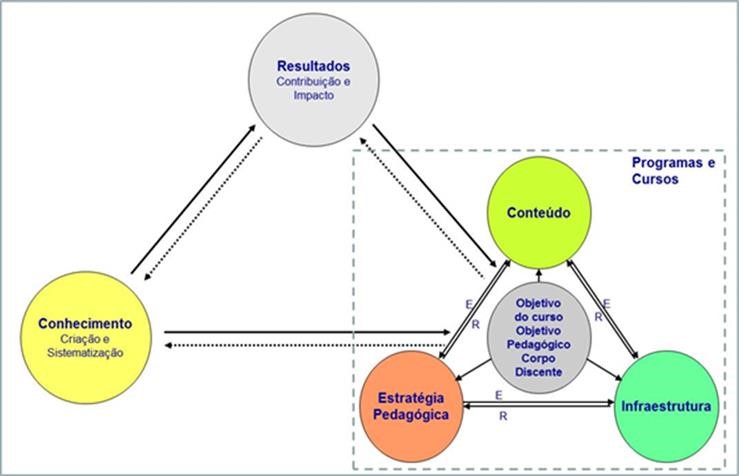
Na parte acadêmica, a dimensão de Conhecimento, com seus professores, pesquisadores e alunos, devem ser a base para uma composição adequada e coerente dos componentes da educação, Programas e Cursos, que por sua vez devem garantir os Resultados esperados e avaliados para o processo de ensino-aprendizagem.
Na parte administrativa, encontram-se os resultados administrativos e os recursos outros, que garantem e relacionam com a parte acadêmica.
A figura 2 apresenta estrutura de gestão de educação, que considera a visão apresentada anteriormente e realça as suas inter-relações.
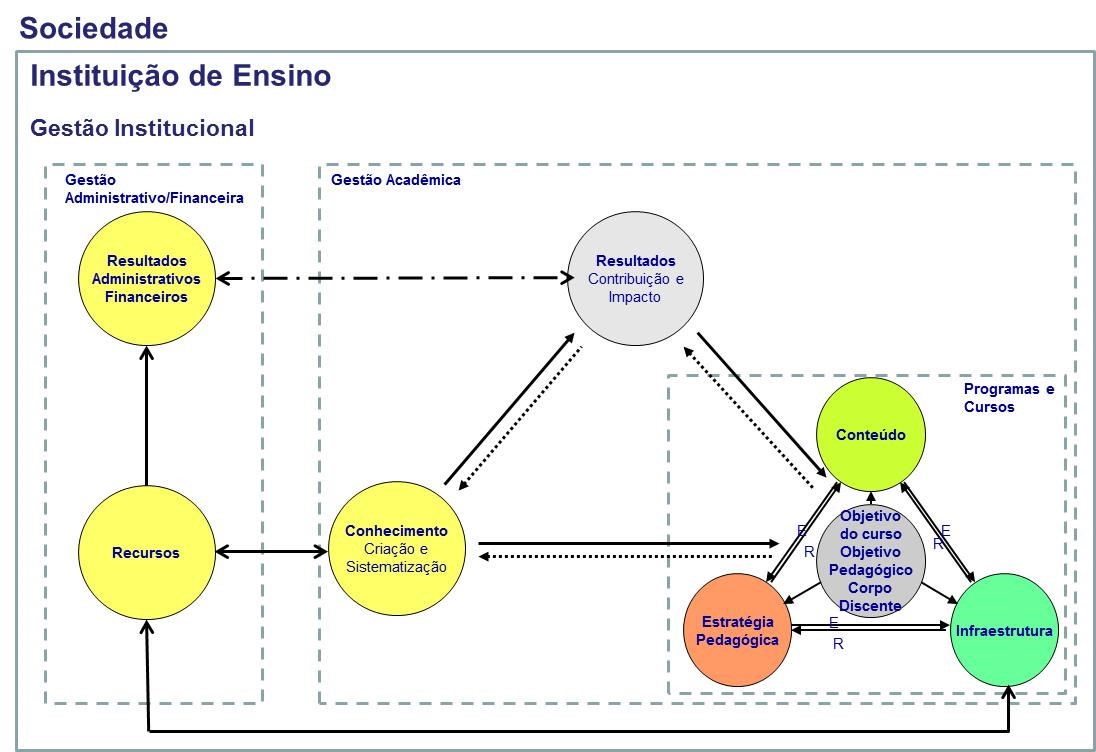
As três áreas de gestão são: institucional, que abrange o nível mais amplo; administrativo/financeiro, que trata dos recursos e resultados gerais da instituição; e acadêmico, no qual estão inseridas as dimensões e os componentes de educação. A gestão institucional se relaciona com a gestão administrativo/financeiro definindo a estratégia de recursos e resultados; e com a gestão acadêmica, definindo sua estratégia. A gestão acadêmica se relaciona com a gestão administrativo/financeiro por intermédio da aplicação dos recursos. Finalmente, as três áreas se relacionam tendo como fundamento o plano pedagógico.
3. Projeto Tecnologia de Informação e Educação
Os Estudos sobre Tecnologia de Informação e Educação têm como objetivo geral a consolidação da estrutura de dimensões e componentes de educação como uma base robusta para estudo de gestão de educação, avaliação institucional de educação e o papel e o poder de transformação da Tecnologia de Informação na Educação. O Projeto Dimensões e Componentes de Educação: uma base para avaliação, realizado com o apoio da CAPES pelo Observatório de Educação, faz parte do conjunto de iniciativas nesta área.
A questão de pesquisa que decorre desta argumentação é: Como ter uma educação de qualidade para toda sociedade, considerando as tendências sociais, econômicas e tecnológicas?
3.1. Objetivo Geral e Objetivos Específicos
O Projeto tem como objetivo geral identificar o papel da Tecnologia de Informação na Educação, considerando qualidade e acesso de toda sociedade, e as tendências sociais, econômicas e tecnológicas.
Os objetivos específicos estão assim definidos:
Consolidar modelo de Gestão de Educação, com suas Dimensões e Componentes.
Realizar estudos de casos de educação nos vários níveis, visando identificar o uso de TI e sua relação com as Dimensões e os Componentes de Educação.
Identificar as tendências transformadoras do uso de TI na Educação.
3.2. Resultados Esperados e Contribuições
A educação é a base para a criação de uma sociedade, o que permite argumentar que deveria ter a máxima qualidade nos seus níveis e garantir o acesso de toda a sociedade.
No Brasil, o crescimento da oferta de educação nos níveis fundamental, médio, superior e pós-graduação, o crescimento da demanda por educação de qualidade, e as diferenças socioeconômicas da sociedade, justificam este projeto.
A contribuição para a prática são os subsídios para os gestores e profissionais de educação para o aproveitamento do potencial do uso de TI para atender as demandas socioeconômicas.
A contribuição acadêmica e científica é a fundamentação teórica e empírica para servir de base para estudos e pesquisas sobre o uso de Tecnologia de Informação na Educação.
3.2.1. Divulgação dos Resultados
Este projeto prevê a divulgação dos seus resultados por meio da:
participação em congressos com submissão de trabalhos sobre os resultados dos projetos integrados;
submissão de artigos para periódicos apresentando os resultados dos projetos integrados; e
divulgação dos principais resultados e working papers no site do FGVcia.
4. Referências
ALBERTIN, Alberto Luiz; ALBERTIN, Rosa Maria de Moura. Education Evaluation based on its Dimensions and Components: An Analysis of Official Graduate Programs Evaluation in Brazil. Business and Management Review, ISSN 2047-0398, v. 4, n. 3, pp. 400-413, dezembro de 2014.
ALBERTIN, A. L. ; ALBERTIN, R. M. M . Avaliação de Educação com Base nas suas Dimensões e Componentes: uma análise da avaliação da CAPES. In: EnPQD 2013, 2013, Brasília. Anais do Em PQD 2013, 2013. v. 1. p. 1-17.
Albertin, A. L., & MOURA, R. M. Informática e a Educação Básica: Elaboração de Cenários Alternativos. 18º ENANPAD, Curitiba, setembro de 1.994