Em andamento
Dimensions of Information Technology Use
Dimensions of Information Technology Use1
1. Context
Information Technology (IT) has been considered one of the most important components of today's business environment, and Brazilian organizations have made extensive and intensive use of this technology, both at a strategic and operational level.
This use offers great opportunities for companies that are successful in taking advantage of the benefits offered by this use. At the same time, it also poses challenges for IT administration, on which companies are now heavily dependent and which presents particular management challenges. In this complex scenario, one of the critical challenges is to identify the level of contribution that this technology makes to company results.
In this environment, it is essential to know the five dimensions of IT use: the use itself, the benefits offered, the contribution to business performance, IT governance and administration, and the role of executives, and the relationship that exists between these dimensions, in order to guarantee their coherence, as well as the individual treatment of the particularities of each one.
2. Dimensions of Information Technology Use
The use of IT in companies must be understood through knowledge of its various dimensions, including the context with its drivers, the types of IT use, business performance, IT governance and management and the role of business and IT executives, as well as the relationship that exists between them. These dimensions are identified in the Model of the Dimensions of the Use of Information Technology for the Benefit of Business, shown in figure 1.

Organizations must define their guidelines, strategies and operations, considering the context in which they operate, taking advantage of the opportunities and overcoming the challenges presented. In this scenario, IT is one of the most important organizational components and has permeated practically all internal and external actions.
In this way, the use of IT must also consider the context, defined in this paper by the drivers of organizational responses and the use of IT, including market pressures, organizational pressures, individual pressures and pressures from the technology itself. The value that IT can add to the organization is directly related to the quality of the study of these drivers.
The use of IT will also be determined by the vision and value that this technology has for the company, as well as the various IT applications that are available to organizations, infrastructure, transactional, informational and strategic (Weill; Broadbent, 19982); and which have different levels of business reconfiguration, depending on the need defined by the drivers. At the highest level, IT can make a definitive contribution to the creation of new business models.
Organizations depend on certain requirements to ensure their success, which can be achieved through the use of IT. The use of IT offers business benefits that include cost, productivity, quality, flexibility and innovation, and each use has its own composition of these benefits. The challenge for organizations is to determine as precisely as possible which ones are actually offered and desired, as this identification will be the basis for confirming these benefits in business performance.
Business performance has certainly been affected by the use of IT, but the way in which this occurs depends on the perspective used in the relationship between the organization and IT, which can range from considering IT as a simple consequence of organizational guidelines, to IT as a facilitator and provider of business innovations. These perspectives determine the value that is given to and expected from the use of IT. Business performance includes both financial and non-financial aspects (Norton; Kaplan, 19963).
IT governance can be understood as the authority and responsibility for decisions regarding the use of IT. IT management, with its planning, organizing, directing and controlling processes, aims to ensure the successful implementation of IT use efforts, from defining it with strategic alignment, influenced by the context, to measuring its impact on business performance (Albertin; Albertin, 20104).
IT management should not only be carried out by IT executives, but is an organizational responsibility in which business executives play a decisive role in its success.
Business executives must have an attitude towards IT that is appropriate to what is expected of this technology, critically and realistically, but also allowing its innovations to be used by organizations as part of their strategy and operations. To this end, they must participate actively and decisively in IT management, together with IT executives.
IT executives must play an active and decisive role in business, just like other executives, but with the particularity of being from an area that permeates all the others and has its own innovation characteristics. They must participate in the business and not only allow, but encourage the participation of other executives.
The dimensions of IT use and their relationships have internal and external effects on organizations, which means that they also influence the context and its drivers, altering them and being altered by them.
3. Dimensions of Information Technology Use Project
The Dimensions of Information Technology Use project focuses on a broad view of the various aspects and factors related to IT use and their interrelationships, including the internal and external environments of organizations.
This broad view makes it possible to study the motivators and antecedents of IT use that are related to the context in which the organization exists, its actors and the technology itself.
The use of IT is also studied, making it possible to understand this technology as a business support created over time and its transformative power through the application of digital innovation.
The value generated by the use of IT is analyzed from the benefits offered by this use to its impact on results that measure business performance with multiple methods and classes of indicators.
The authority and responsibilities for decisions regarding the use of IT are studied by IT governance, which relates to corporate governance and IT administration itself.
This broad vision is represented by the research question: What are the dimensions involved in the use of IT and how do they relate?
3.1. General Objective and Specific Objectives
The main objective of the Dimensions of Information Technology Use project is to identify the dimensions of IT use and the relationship between them.
The specific objectives are defined as follows:
Identify the drivers of Information Technology use.
Identify the benefits offered by Information Technology.
To identify the challenges of IT governance and management.
To identify the attitudes of executives towards Information Technology.
Identify the relationship between the benefits and challenges of Information Technology, and these with company performance and executive attitudes.
To identify the relationship between the benefits of Information Technology and company performance, establishing links.
To identify the existence of coherence between the Dimensions of Information Technology Use.
3.2 Expected Results and Contributions
The Dimensions of Information Technology Use project.
The knowledge resulting from this research is a contribution to company managers who are involved with the use of IT as part of their strategy and operation, facing the challenges of managing it in order to take advantage of the opportunities offered and mitigate the risks inherent in this use.
The contribution of the research is the identification of the benefits offered by IT, the challenges of its management, the possible relationships with business performance and the attitudes of executives towards this technology, identifying the current IT scenario in Brazilian companies and offering important subsidies for its management. In addition to identification, the research project aims to develop an instrument not only for analysis and evaluation, but also to provide guidance on how to properly deal with these dimensions.
3.2.1 Dissemination of results
This project plans to disseminate its results by:
participating in congresses and submitting papers on the project's results;
submitting articles to journals presenting the project's results; and
publication of the main results and working papers on the FGVcia website.
1Albertin, A. L. and Albertin, R. M. M. Tecnologia de Informação e Desempenho Empresarial: As Dimensões de seu Uso e sua Relação com os Benefícios de Negócio. São Paulo: Atlas, 3rd edition, 2016.
2Weill, P.; Broadbent, M. Leavering the new infrastruture: how market leaders capitalize on IT. Boston: Harvard Business School Press, 1998.
3Kaplan, R. S. and Norton, D. P. The Balanced Scorecard: Translating Strategy into Action. Boston: Harvard Business School Press, 1996.
4Albertin, R. M. M and Albertin, A. L. Estratégias de Governança de Tecnologia de Informação: Estrutura e Práticas . São Paulo: Elsevier, 2010.

1. Contexto
A Tecnologia de Informação (TI) tem sido considerada um dos componentes mais importantes do ambiente empresarial atual, sendo que as organizações brasileiras têm utilizado ampla e intensamente esta tecnologia, tanto em nível estratégico como operacional.
Essa utilização oferece grandes oportunidades para as empresas que têm sucesso no aproveitamento dos benefícios oferecidos por este uso. Ao mesmo tempo, ele também oferece desafios para a administração de TI do qual as empresas passam a ter grande dependência e que apresenta particularidades de gerenciamento. Neste cenário complexo, um dos desafios críticos é identificar o nível de contribuição que esta tecnologia oferece aos resultados das empresas.
Neste ambiente, torna-se imprescindível o conhecimento das cinco dimensões do uso de TI: utilização em si, benefícios oferecidos, contribuição para o desempenho empresarial, governança e administração de TI, e o papel dos executivos, e da relação que existe entre estas dimensões, para que se possa garantir a sua coerência, além do tratamento individual das particularidades de cada uma delas.
2. Dimensões do Uso de Tecnologia de Informação
O uso de TI nas empresas deve ser entendido por meio do conhecimento das suas várias dimensões, incluindo o contexto com seus direcionadores, os tipos de uso de TI, o desempenho empresarial, a governança e a administração de TI e o papel dos executivos de negócio e de TI, bem como a relação que existe entre elas. Estas dimensões são identificadas no Modelo das Dimensões do Uso de Tecnologia de Informação em Benefício dos Negócios, apresentado na figura 1.
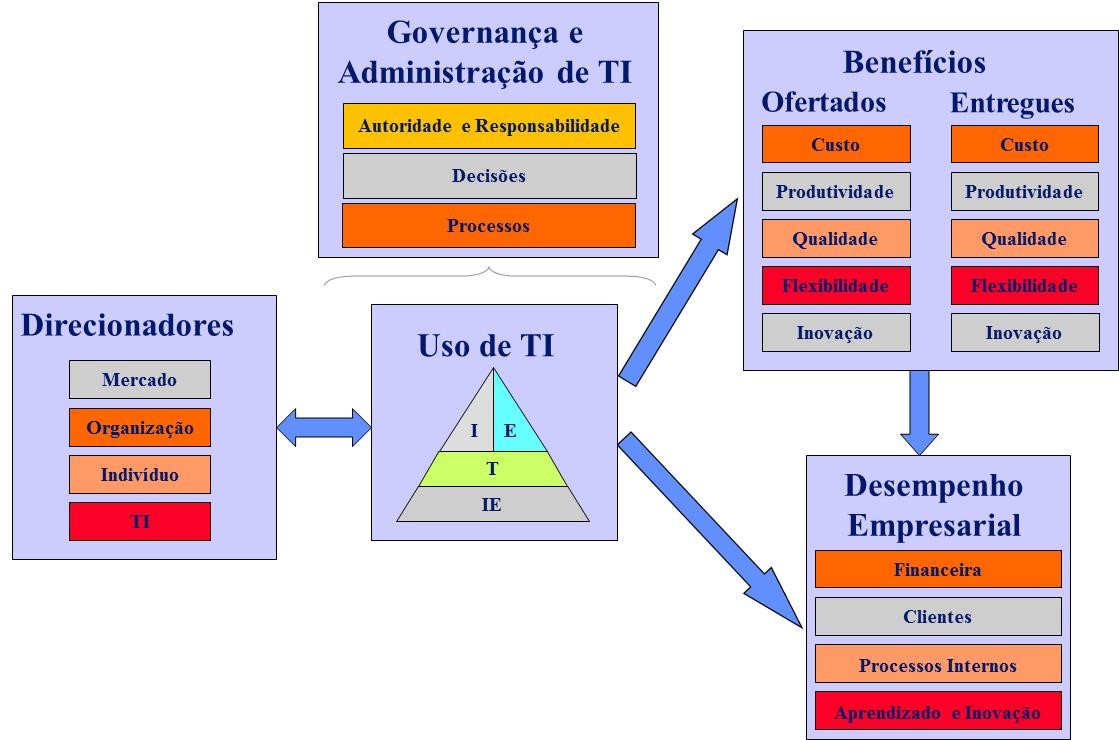
As organizações devem definir as suas diretrizes, estratégias e operacionalização, considerando o contexto em que atuam, aproveitando as oportunidades e vencendo os desafios apresentados. Neste cenário, a TI é um dos componentes organizacionais mais importantes e tem permeado praticamente todas as ações internas e externas.
Desta forma, o uso de TI também deve considerar o contexto, definido neste trabalho pelos direcionadores das respostas organizacionais e do uso de TI, incluindo as pressões de mercado, organizacionais, de indivíduo e da própria tecnologia. O valor que a TI poderá agregar à organização está diretamente relacionado com a qualidade do estudo destes direcionadores.
O uso de TI também será determinado pela visão e valor que esta tecnologia tem para a empresa, assim como pelas várias aplicações de TI que estão à disposição das organizações, infraestrutura, transacional, informacional e estratégico (Weill; Broadbent, 19982); e que tem níveis diferentes de reconfiguração de negócio, dependendo da necessidade definida pelos direcionadores. No nível mais elevado, a TI pode contribuir de forma definitiva para a criação de novos modelos de negócio.
As organizações dependem de certos requisitos para garantirem seu sucesso que podem ser alcançados com a utilização de TI. O uso de TI oferece benefícios para os negócios que incluem custo, produtividade, qualidade, flexibilidade e inovação, sendo que cada uso tem uma composição própria destes benefícios. O desafio das organizações é determinar o mais precisamente possível quais os realmente ofertados e desejados, pois esta identificação será a base para a confirmação destes benefícios no desempenho empresarial.
O desempenho empresarial certamente tem sido afetado pelo uso de TI, porém a maneira que isto ocorre depende da perspectiva usada na relação entre a organização e a TI, que pode ser desde a consideração de TI como simples decorrência das diretrizes organizacionais, até a TI como facilitadora e fornecedora de inovações de negócio. Estas perspectivas determinam o valor que é dado e que se espera do uso de TI. O desempenho empresarial inclui aspectos financeiros e não financeiros (Norton; Kaplan, 19963).
A governança de TI pode ser entendida como a autoridade e responsabilidade pelas decisões referentes ao uso de TI. A administração de TI, com seus processos de planejamento, organização, direção e controle, tem como objetivo garantir a realização bem sucedida dos esforços para o uso de TI, desde a sua definição com o alinhamento estratégico, influenciado pelo contexto, até a mensuração dos seus impactos no desempenho empresarial (Albertin; Albertin, 20104).
A administração de TI não deve ser realizada apenas pelos executivos desta área, mas é uma responsabilidade organizacional da qual os executivos de negócio têm participação decisiva no seu sucesso.
Os executivos de negócio devem ter uma atitude em relação com a TI adequada ao que se espera desta tecnologia, de forma crítica e realista, mas também permitindo que as suas inovações sejam aproveitadas pelas organizações como parte de sua estratégia e operacionalização. Para tanto, eles devem participar ativa e decisivamente na administração de TI em conjunto com os executivos desta área.
Os executivos de TI devem ter um papel ativo e decisivo nos negócios, assim como os demais executivos, mas com a particularidade de serem de uma área que permeia todas as demais e tem características próprias de inovação. Eles devem participar nos negócios e não só permitir, mas incentivar a participação dos demais executivos.
As dimensões do uso de TI e suas relações produzem efeitos internos e externos nas organizações, o que significa que elas também influenciam o contexto e seus direcionadores, alterando-os e sendo alteradas por eles.
3. Projeto Dimensões do Uso de Tecnologia de Informação
O projeto Dimensões do Uso de Tecnologia de Informação tem como foco a visão ampla dos vários aspectos e fatores relacionados com o uso de TI e suas inter-relações, incluindo os ambientes internos e externos das organizações.
Esta visão ampla permite estudar os motivadores e antecedentes do uso de TI que estão relacionados com o contexto em que a organização existe, seus atores e a própria tecnologia.
O uso de TI também é estudado permitindo entender esta tecnologia como sustentação dos negócios criada ao longo do tempo e o seu poder transformador pela aplicação de inovação digital.
O valor gerado pelo uso de TI é analisado desde os benefícios oferecidos por este uso até o seu impacto nos resultados que medem o desempenho empresarial com múltiplos métodos e classes de indicadores.
A autoridade e as responsabilidades pelas decisões referentes ao uso de TI são estudadas pela governança de TI que se relaciona com a governança corporativa e com a própria administração de TI.
Esta visão ampla é representada pela questão de pesquisa: Quais são e como se relacionam as dimensões envolvidas com o uso de TI?
3.1. Objetivo Geral e Objetivos Específicos
O projeto Dimensões do Uso de Tecnologia de Informação tem como objetivo principal identificar as dimensões do uso de TI e a relação entre elas.
Os objetivos específicos estão assim definidos:
Identificar os direcionadores do uso de Tecnologia de Informação.
Identificar os benefícios oferecidos pela Tecnologia de Informação.
Identificar os desafios da governança e da administração de Tecnologia de Informação.
Identificar as atitudes dos executivos em relação à Tecnologia de Informação.
Identificar a relação dos benefícios e desafios da Tecnologia de Informação, e destes com o desempenho das empresas e com a atitude dos executivos.
Identificar a relação entre os benefícios da Tecnologia de Informação e o desempenho das empresas, estabelecendo vínculos.
Identificar a existência de coerência entre as Dimensões do Uso de Tecnologia de Informação.
3.2. Resultados Esperados e Contribuições
O projeto Dimensões do Uso de Tecnologia de Informação.
O conhecimento resultante dessa pesquisa é uma contribuição para os gestores de empresas que estão envolvidos com o uso de TI como parte de sua estratégia e operação, enfrentando os desafios de sua administração para o aproveitamento das oportunidades oferecidas e mitigação dos riscos inerentes a esta utilização.
A contribuição da pesquisa é a identificação dos benefícios oferecidos pela TI, os desafios de sua administração, as possíveis relações com os desempenhos empresariais e as atitudes dos executivos em relação a esta tecnologia, identificando o cenário atual de TI nas empresas brasileiras e oferecendo subsídios importantes para a sua administração. Além da identificação, o projeto de pesquisa visa elaborar um instrumento não só de análise e avaliação, mas também de orientação para o tratamento adequado destas dimensões.
3.2.1. Divulgação dos Resultados
Este projeto prevê a divulgação dos seus resultados por meio da:
participação em congressos com submissão de trabalhos sobre os resultados do projeto;
submissão de artigos para periódicos apresentando os resultados do projeto; e
divulgação dos principais resultados e working papers no site do FGVcia.
Albertin, A. L. e Albertin, R. M. M. Tecnologia de Informação e Desempenho Empresarial: As Dimensões de seu Uso e sua Relação com os Benefícios de Negócio. São Paulo: Atlas, 3ª edição, 2016.
Weill, P.; Broadbent, M. Leavering the new infrastruture: how market leaders capitalize on IT. Boston: Harvard Business Scholl Press, 1998.
Kaplan, R. S. e Norton, D. P. The Balanced Scorecard: Translating Strategy into Action. Boston: Harvard Business School Press, 1996.
Albertin, R. M. M e Albertin, A. L. Estratégias de Governança de Tecnologia de Informação: Estrutura e Práticas. São Paulo: Elsevier, 2010.