Em andamento
Artificial Intelligence for Social and Environmental Sustainability, and Business
ALBERTIN, A. L., full professor at FGV EAESP and coordinator of FGVcia
ALBERTIN. R. M. M., researcher at FGVcia.
Information Technology has always been evolving since it first appeared, both in terms of its supply and its use by organizations. This evolution has presented clear cycles of technological innovation that have led to cycles of innovation in technology products and services, which in turn have led to cycles of innovation in their use by organizations.
Currently, with the greater availability, access and ease of use of digital technologies, society and companies have sought to intensify the innovation made possible by this use, digital innovation. More specifically, innovating with artificial intelligence to transform and create value for society and business.
To better understand the Digital Transformation phenomenon, it is necessary to understand the motivators that lead a company to assimilate digital technologies so intensely in order to do something new, different and better; the digital technologies themselves and their characteristics that make this transformation possible; the conditions necessary to increase the chances of these transformations occurring and being successful; the transformation itself represented by the application of digital technologies for disruptive change; and the value generated by the transformation.
In the broader context, society is facing unprecedented social and environmental problems, many attributed to the consequences of actions by organizations that generate negative impacts and/or have not considered the need to generate positive impacts and compensation. The responsibility for reducing the causes and impacts already present, as well as leveraging sustainable development, lies with everyone, both the private sector and the public sector. It is worth noting that many organizations already generate positive impacts and contribute to sustainable development, and are seeking to improve their efforts with the use of digital technologies.
The challenges of sustainable development, both social and environmental, have been growing, as has the pressure on organizations to make a significant contribution to overcoming them. To do so, they must use their resources, including the use of digital technologies, not only for strictly business results, but also for social and environmental sustainability.
In this general context, the problem associated with responsibility for sustainable development can be understood as the need to reduce the negative impacts already perceived and predicted, while at the same time contributing to their improvement and guarantee, with a view to the future of society in its various dimensions. This contribution includes eliminating, or at least minimizing, negative externalities and maximizing positive ones, both of which are the consequences of the actions of organizations that affect third parties, without them bearing the costs or charging for them.
In view of this, the Artificial Intelligence for Social and Environmental Sustainability and Business research project seeks to contribute to knowledge about the use of artificial intelligence, associated with digital technologies, to enable, support and innovate in the internal and external efforts of organizations linked to social and environmental sustainability and business.
The use of AI and associated digital technologies for social and environmental sustainability, and for business, must consider the dimensions, theories and concepts, in particular, of the Dimensions of the Use of Information Technology of the Dimensions of Digital Transformation (Albertin and Albertin, 2021). The figure shows the Artificial Intelligence Model for Social and Environmental Sustainability, and Business, which will be considered as the research model.

The project's main objective is to identify the use of artificial intelligence and associated technologies for social and environmental sustainability, and for business, considering their motivators, context and value generated.
The Artificial Intelligence for Social and Environmental Sustainability and Business research project is divided into 7 (seven) phases:
1. Review of the Proposed Artificial Intelligence Model for Social and Environmental Sustainability and Business:
2. Situation Analysis of Artificial Intelligence for Sustainability in the Main Sectors
3. Consolidation of the Artificial Intelligence Model for Social and Environmental Sustainability and Business
4. Identification of the Uses of Artificial Intelligence for Sustainability
5. Identifying the Uses of Artificial Intelligence in Negative and Positive Externalities
6. Identifying the Value of the Uses of Artificial Intelligence for Sustainability
7. Artificial Intelligence Observatory for Social and Environmental Sustainability
ALBERTIN, A. L.; ALBERTIN, R. M. M. (2024). Artificial Intelligence for Social and Environmental Sustainability, and Business. Working paper.
ALBERTIN, A. L.; ALBERTIN, R. M. M. (forthcoming). Dimensions of Digital Transformation: a framework for strategy, analysis and evaluation. International Journal of Business Innovation and Research. DOI: 10.1504/IJBIR.2023.10057838.
ALBERTIN, A. L.; ALBERTIN, R. M. M. (2021). DIGITAL TRANSFORMATION: GENERATING VALUE FOR THE "NEW FUTURE". GVexecutivo, vol. 20, n. 1, pp. 26-29, jan/mar 2021. DOI: 10.12660/gvexec.v20n1.2021.83455.
Digital Transformation Observatory: https://eaesp.fgv.br/centros/centro-tecnologia-informacao-aplicada/proje....

A Tecnologia de Informação sempre esteve em evolução desde o seu surgimento, tanto na sua oferta como no seu uso pelas organizações. Esta evolução apresentou ciclos claros de inovação tecnológica que levaram a ciclos de inovação de produtos e serviços de tecnologia, que por sua vez permitiram ciclos de inovação de seu uso pelas organizações.
Atualmente, com a maior disponibilidade, acesso e facilidade de uso das tecnologias digitais, a sociedade e as empresas têm buscado intensificar a inovação possibilitada por este uso, a inovação digital. Mais especificamente, inovar com inteligência artificial para transformar e criar valor para a sociedade e para os negócios.
Para melhor entendimento do fenômeno Transformação Digital, é necessário entender os motivadores que levam uma empresa a assimilar as tecnologias digitais de forma tão intensa para fazer algo novo, diferente e melhor; as próprias tecnologias digitais e suas características que viabilizam esta transformação; as condições necessárias para aumentar as chances destas transformações ocorrerem e serem bem sucedidas; a transformação em si representada pela aplicação das tecnologias digitais para mudança disruptiva; e o valor gerado pela transformação.
No contexto mais amplo, a sociedade enfrenta problemas sociais e ambientais sem precedentes, muitos atribuídos às consequências de ações de organizações que geram impactos negativos e/ou não consideraram a necessidade de gerar impactos positivos e compensações. As responsabilidades para reduzir as causas e impactos já presentes, bem como para alavancar o desenvolvimento sustentável são de todos, tanto da iniciativa privada como pública. Cabe ressaltar que muitas organizações já geram impactos positivos e contribuem para o desenvolvimento sustentável, e buscam aprimorar seus esforços com o uso de tecnologias digitais.
Os desafios do desenvolvimento sustentável, tanto social como ambiental, têm sido crescentes, assim como a pressão para que as organizações contribuam de forma significativa para vencê-los. Para isso, devem empregar seus recursos, incluindo o uso de tecnologias digitais, não apenas para os resultados estritamente de negócios, mas também para a sustentabilidade social e ambiental.
Neste contexto geral, o problema associado à responsabilidade sobre o desenvolvimento sustentável pode ser entendido como a necessidade de reduzir os impactos negativos já percebidos e previstos, ao mesmo tempo contribuir para a sua melhora e garantia, visando o futuro da sociedade nas suas várias dimensões. Esta contribuição inclui eliminar, ou pelo menos minimizar, as externalidades negativas, e maximizar as positivas, ambas são as consequências das ações das organizações que afetam terceiros, sem que elas arquem com os custos ou cobrem por elas.
Diante disso, o projeto de pesquisa Inteligência Artificial para Sustentabilidade Social e Ambiental, e Negócios busca contribuir para o conhecimento sobre o uso de inteligência artificial, associada às tecnologias digitais, para viabilizar, suportar e inovar nos esforços internos e externos das organizações vinculados com sustentabilidade social e ambiental, e negócios.
O uso de IA e tecnologias digitais associadas, para a sustentabilidade social e ambiental, e para os negócios, deve considerar as dimensões, teorias e conceitos, em especial, das Dimensões do Uso de Tecnologia de Informação das Dimensões de Transformação Digital (Albertin e Albertin, 2021). A figura apresenta o Modelo de Inteligência Artificial para Sustentabilidade Social e Ambiental, e Negócios, que será considerado como modelo de pesquisa.
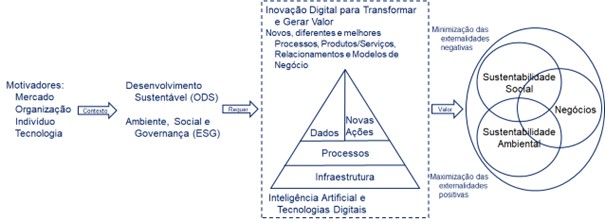
Fonte: Albertin e Albertin, 2024
O Projeto tem como objetivo principal identificar o uso de inteligência artificial e tecnologias associadas para sustentabilidade social e ambiental, e para os negócios, considerando seus motivadores, contexto e valor gerado.
O projeto de pesquisa Inteligência Artificial para Sustentabilidade Social e Ambiental, e Negócios está dividido em 7 (sete) fases:
1. Revisão do Modelo Proposto de Inteligência Artificial para Sustentabilidade Social e Ambiental, e Negócios:
2. Análise da Situação de Inteligência Artificial para Sustentabilidade nos Principais Setores
3. Consolidação do Modelo de Inteligência Artificial para Sustentabilidade Social e Ambiental, e Negócios
4. Identificação dos Usos de Inteligência Artificial para Sustentabilidade
5. Identificação dos Usos de Inteligência Artificial nas Externalidades Negativas e Positivas
6. Identificação do Valor dos Usos de Inteligência Artificial para Sustentabilidade
7. Observatório de Inteligência Artificial para Sustentabilidade Social e Ambiental
ALBERTIN, A. L.; ALBERTIN, R. M. M. (2024). Inteligência Artificial para Sustentabilidade Social e Ambiental, e Negócios. Working paper.
ALBERTIN, A. L.; ALBERTIN, R. M. M. (forthcoming). Dimensions of Digital Transformation: a framework for strategy, analysis and evaluation. International Journal of Business Innovation and Research. DOI: 10.1504/IJBIR.2023.10057838.
ALBERTIN, A. L.; ALBERTIN, R. M. M. (2021). TRANSFORMAÇÃO DIGITAL: GERANDO VALOR PARA O “NOVO FUTURO”. GVexecutivo, vol. 20, n. 1, pp. 26-29, jan/mar 2021. DOI: 10.12660/gvexec.v20n1.2021.83455.
Observatório de Transformação Digital: https://eaesp.fgv.br/centros/centro-tecnologia-informacao-aplicada/proje....
