Project promotes immersion that explores urban and environmental challenges in Baixada Santista
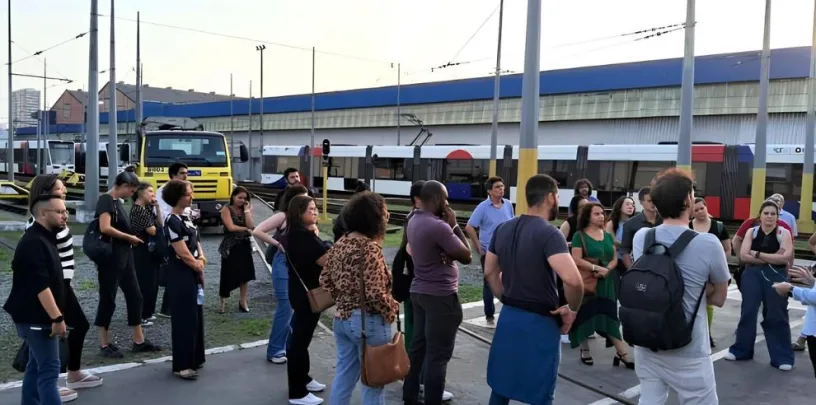
Students of the Professional Master's in Management and Public Policy (MPGPP) at the São Paulo School of Business Administration (FGV EAESP) took part in an immersion in Baixada Santista between October 15 and 17. The activity, which involved 37 students, 2 professors and a monitor, aimed to offer practical experience in infrastructure governance, allowing students to interact directly with the realities and challenges of urban and environmental management in that metropolitan region.
The partnership was established with the State Secretariat for Urban Development and Housing and the Metropolitan Agency of Baixada Santista (AGEM BS), in addition to several public and private institutions. The partners involved included the Port Authority of Santos and the Metropolitan Urban Transport Company (EMTU), as well as the city governments of Bertioga, Praia Grande and São Vicente, SESC and the Catholic University of Santos. This collaboration allowed students to have direct contact with highly relevant projects, and the students discussed topics such as urban mobility, waste management, cargo transportation, port operations, housing and climate emergency.
Day 1: Urban Mobility and Integrated Public Transport
On the first day, students had the opportunity to explore urban mobility systems and integrated public transportation. They learned about the operation of the Light Rail Vehicle (VLT) between Santos and São Vicente, an important project for the region. In addition, they were able to understand the expansion of the cycle path network and the efforts of city governments to integrate different modes of transportation, promoting greater sustainability and efficiency in urban travel. The students also visited the Operational Control Center and saw the importance of adopting a systemic approach to creating effective public policies, a point that was highlighted throughout the discussions, emphasizing the role of infrastructure in the use and occupation of urban land.
Day 2: Sustainability and the Port of Santos
On the second day, one of the main focuses was sustainability. The students visited the waste biodigestion plant in Bertioga, where they learned about solutions adopted for waste management, composting and clean energy generation. The visit also highlighted the role of climate resilience and innovation in environmental management in the region. The students also visited the Port of Santos, the largest in Latin America, where they learned about the complex port logistics and the challenges of cargo transportation and maritime infrastructure, as well as the challenges of integrating the port and the city, between port operations and urban and metropolitan management.
Day 3: Innovative projects
On the last day of the immersion, the focus was on contact with a series of new projects developed in the Baixada Santista Metropolitan Region. The first of these was the project to build an underwater tunnel that will connect Santos to Guarujá, an initiative that will connect the public and private sectors with the aim of solving the classic problem of interconnection between the two cities. The SIMM - Metropolitan and Municipal Information System was also presented, aimed at mapping and managing housing policy, with a strong emphasis on looking at the favelas that exist in all cities in the region, and conducted by CDHU in partnership with the Geographic and Cartographic Institute. Finally, they learned about the initiatives of the Catholic University of Santos in supporting AGEM and municipalities to develop technical capabilities in sustainability, smart cities and climate action.
These field experiences complemented the students’ academic training throughout the program, offering an in-depth understanding of the challenges faced by public managers in the contemporary context. Professor Luis Paulo Bresciani , vice-coordinator of the course, highlighted that “dealing with a specific region, such as Baixada Santista, and a structural theme such as infrastructure governance, allowed our students to expand their knowledge, learn about real initiatives and problems for the population, for the territory, and for the formulators and implementers of public policies.”
For the Undersecretary of Urban Development and Housing, José Police Neto , who accompanied the activities, this initiative is essential for the development of strategic projects for the region. “The Baixada Santista Metropolitan Region was chosen by FGV to immerse professionals in development. Now the challenge is to propose solutions, new concepts or innovative points of view for Metropolitan Governance,” he says.
The executive director of AGEM BS, Thiago Wiggert , states that the partnership with FGV is essential for the development and debate on metropolitanization. “We need academic support so that we can discuss effective actions, whether in the fight against climate change or other projects that guarantee quality of life for the population. The presence of FGV students from various regions of the country has become even more enriching for the debate on metropolitanization.”
The interaction between academia and government was another strong point of the activity, allowing students to propose innovative solutions to the problems observed. This exchange of knowledge reinforces the importance of practice in the teaching-learning process of the MPGPP, in addition to reflecting and supporting sustainable development, metropolitan governance and the effectiveness of public policies in Baixada Santista.
To learn more about the Professional Master's Degree in Management and Public Policy, visit the website .