Master’s Program presents Brazilian packaging ecosystem to international students
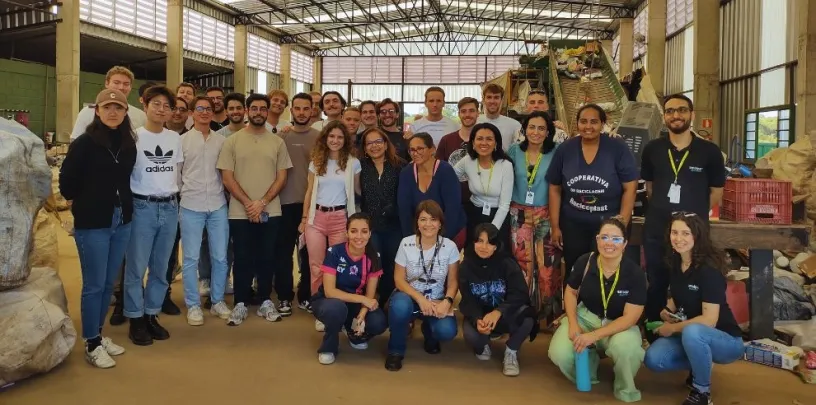
In an effort to integrate theory and practice in a global context, 23 students from the Professional Master’s in International Management (MPGI) at the São Paulo School of Business Administration (FGV EAESP) participated in an immersive seminar on innovation and the circular economy in Brazil. These students, from 13 nationalities and 16 different universities, spent a week exploring the circular value chain of the Brazilian packaging ecosystem.
Block Seminar: Focus on Circular Economy
Held between July 30 and August 2, this year's Block Seminar had the theme " Innovation and Circular Economy for Social Impact " and was taught by FGV EAESP professors Susana Pereira and Cristina Sartoretto . Over four days, students attended lectures by experts, visited companies and faced a practical challenge. Speakers included Fabrício Soler , an attorney specializing in environmental law, and Gustavo Loiola , leadership education manager at the UN Global Compact.
Students visited three companies to better understand the circular packaging value chain in Brazil:
- Cazoolo, Braskem’s Circular Packaging Design Lab: In this innovation hub, students learned about sustainable packaging solutions and the impact of these innovations on the circular economy. Yuri Carvalho , Head of Cazoolo, explained how design is crucial to sustainability.
- Natura & Co.: After visiting the Natura factory in Cajamar, Sergio Talocchi , manager of sustainable chains for Latin America, discussed how the company works to improve the circularity of its products and the challenges faced in this journey.
- Ambipar Group: the group is a leader in environmental management, operating on several fronts, and the visit was essential for the students to learn about and understand the Brazilian reality in the solid waste chain. There, they were able to see the realities of the cooperatives and their implementation process. They were also able to visit the group's Research & Development laboratory and training center, which focuses on occupational risk prevention and workplace safety.
The Practical Challenge
The students were divided into groups to face a challenge: " How to improve post-consumer waste management in Brazil with the participation of collectors and cooperatives? " With mentoring from the program's professors and Edy Merendino , a specialist in circular economy, the groups developed social impact initiatives, proposing new products, services, business models or management practices.
Brazilian Context and Social Impact
For many of these international students, it was their first time to come into contact with the reality of waste pickers , a crucial figure in the recycling process in Brazil, but nonexistent in many of their countries of origin. Immersion in the Brazilian context provided a deep understanding of the complexities of solid waste management, including legal, social and technological aspects.
The Block Seminar not only provided in-depth knowledge about the circular economy and sustainable innovation in Brazil, but also challenged students to think critically and develop practical solutions to real-world problems. This experience, rich in learning and networking, highlighted the importance of international collaboration in the pursuit of a more sustainable future.
The participation of FGV EAESP MPGI/CEMS students in the Block Seminar reinforces the relevance of academic programs that combine theoretical rigor with practical application, preparing global leaders to face complex challenges with innovative and socially responsible solutions.
More about the structure of the MPGI/CEMS Program
MPGI is part of the prestigious CEMS Alliance, which brings together 33 of the world’s top business schools. Students in this program attend up to two different universities during their master’s degree, spending up to six months at each institution. In São Paulo, at FGV, the diverse group began their journey with the Block Seminar, a mandatory and intense course that marks the first week at the university.
For more information about MPGI, click here .