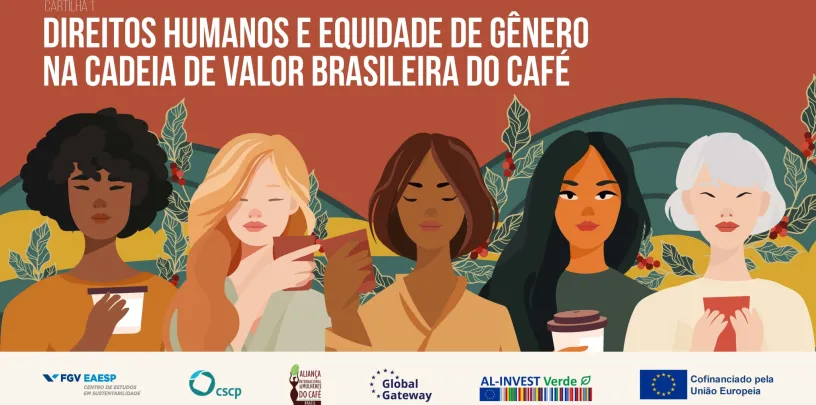
Booklet 1 – Human Rights and Gender Equity in the Brazilian Coffee Value Chain
This booklet aims to disseminate and highlight collective learnings and experiences related to human rights and the empowerment of women within the Brazilian coffee value chain. The content presented here was developed during the 1st Training Cycle on Good Sustainability Practices of the ARABICA-CANEPHORA Project, carried out by the Center for Sustainability Studies of Fundação Getulio Vargas (FGVces), in partnership with the Collaborating Centre on Sustainable Consumption and Production (CSCP) and the International Women’s Coffee Alliance (IWCA Brazil), between 2024 and 2025.
Co-funded by the European Union’s AL-INVEST Verde Programme, the project aimed to strengthen sustainability, equity, and traceability in Brazil’s coffee supply chain, with particular attention to women and youth-led smallholder producers and small and medium-sized enterprises (SMEs). To this end, the initiative included a range of activities, including a training pathway that reached nearly 200 women coffee producers representing different segments of the value chain across the country, particularly in the regions of Southern Minas, Matas de Minas, and Cerrado Mineiro (Minas Gerais), Chapada Diamantina (Bahia), and Eastern Rondônia.
With the aim of sharing the knowledge produced and the insights collectively developed throughout this process, the team is launching a series of thematic booklets related to the content addressed during three training workshop cycles. This booklet focuses on Human Rights and Gender Equity in the coffee value chain. It is part of a series that also covers the themes of Decent Work and Climate Change Adaptation. The content presented in this series reflects the research conducted by the Project team (FGVces, CSCP, and IWCA Brazil) for each workshop, as well as the discussions and exchanges that took place during meetings with women coffee producers, bringing together the experiences and contributions of those directly engaged in coffee production.
Intended for coffee producers, rural workers, cooperatives, associations, purchasing companies, certification bodies, technical agencies, civil society organizations, and public policymakers, this booklet seeks to inspire reflection and action. Its purpose is to disseminate knowledge and good practices that promote human rights, gender equity, and the productive inclusion of women in rural areas under fair, safe, healthy, and equitable conditions.
Access the Spanish and Portuguese versions.
